





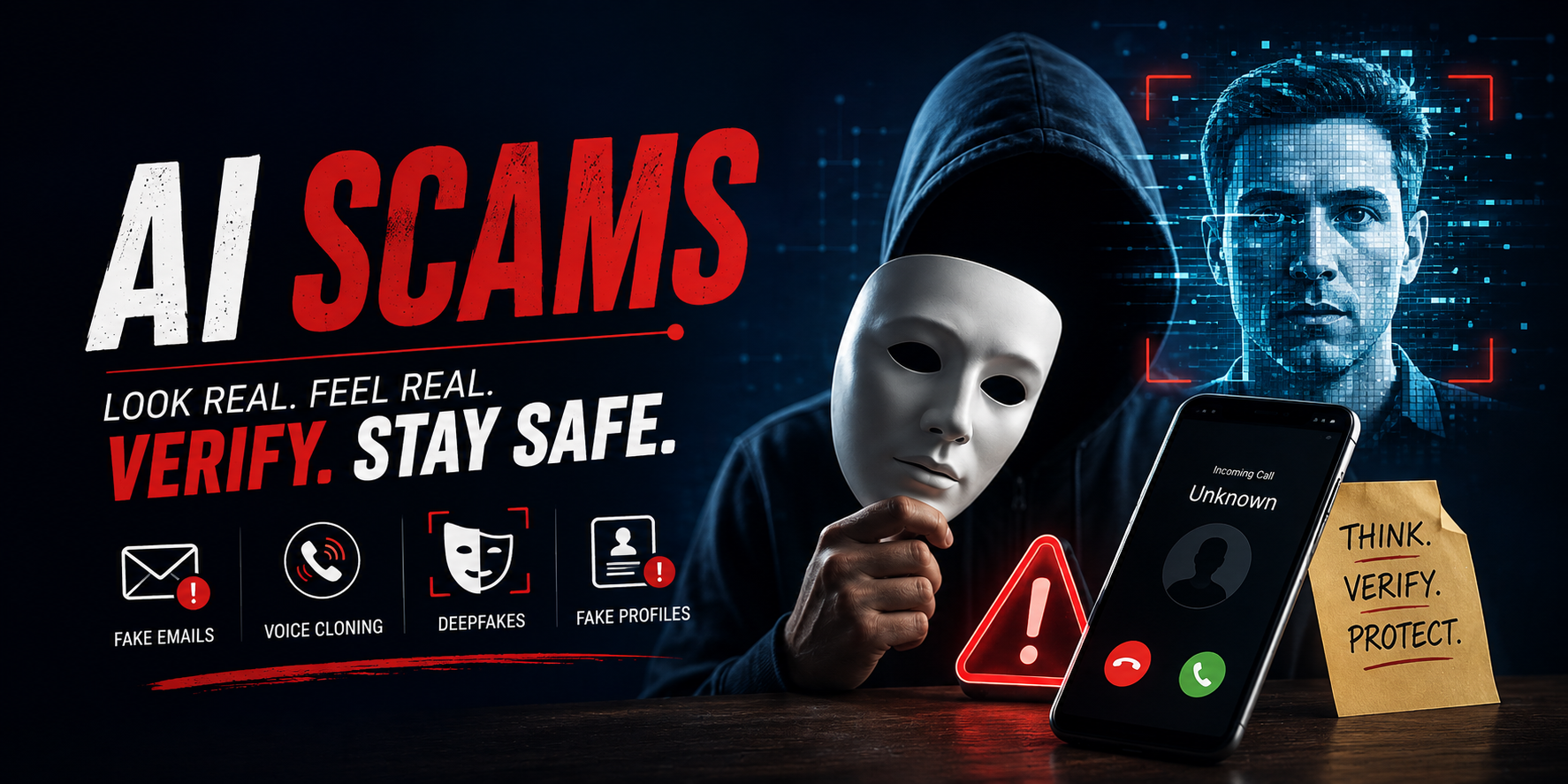
Scammers have always used tricks to fool people. However, artificial intelligence (AI) is making those tricks more convincing and harder to spot.
Today, criminals can create realistic emails, fake social media profiles, cloned voices, AI-generated images, and fake videos. They can also use AI to personalize messages, making a scam feel much more real.
As a result, familiar scams such as phishing, romance fraud, investment scams, and impersonation scams are becoming harder to recognize.
The FBI’s 2025 Internet Crime Report recorded 22,364 complaints involving AI-related information, with reported losses of more than $893 million. The report also says that synthetic content is becoming easier to create and harder to identify.
Fortunately, you do not need to be an AI expert to protect yourself.
The most important rule is simple:
Do not trust a message, voice, photo, video, or profile just because it looks real. Always verify it before taking action.
What Is an AI Scam?
An AI scam is a type of fraud that uses artificial intelligence to make deception more realistic, personal, or easier to carry out.
For example, scammers may use AI-generated text, fake photos, voice cloning, deepfake videos, or chatbots. They can then pretend to be a friend, family member, company, expert, or government official.
Their main goals are to:
- Steal money
- Collect passwords
- Obtain personal information
- Trick people into clicking harmful links
- Gain access to online accounts
- Convince victims to make payments
In other words, AI does not always create a completely new type of scam. Instead, it often makes existing scams more believable and easier to run at a larger scale.
Why Are AI Scams So Hard to Spot?
In the past, people often looked for spelling mistakes, poor grammar, strange messages, or low-quality images.
Today, those warning signs are less useful.
AI can help scammers create:
- Professional emails
- Personalized text messages
- Realistic photographs
- Fake social media profiles
- Cloned voices
- Manipulated videos
- Fake documents
- Investment promotions
- Customer-service conversations
Therefore, good grammar does not mean a message is safe.
A scammer can use AI to create a message that sounds professional and convincing. For this reason, verification is now more important than appearance.
What Are the Most Common AI Scams?
AI can be used in many forms of online fraud. The most common examples include voice scams, deepfake scams, phishing, fake profiles, romance scams, investment fraud, and business impersonation.
Let’s look at each type and the warning signs to watch for.
1. AI Voice Cloning Scams
Voice cloning is one of the most worrying forms of AI fraud.
Imagine receiving a call from someone who sounds exactly like your child, parent, partner, or friend. The caller says there is an emergency and asks for money immediately.
The voice may sound completely real. However, it could have been created with AI.
The FTC warns that scammers can use a short recording of someone’s voice to create a convincing imitation. They may then use that cloned voice in a fake emergency scam.
Common warning signs include:
- The caller demands money immediately.
- They claim there is an emergency.
- They tell you to keep the situation secret.
- They request gift cards or cryptocurrency.
- They ask for a wire transfer.
- They refuse to let you verify the story.
What should you do?
First, end the call.
Then, contact the person directly using a phone number you already know. Do not use a number provided by the caller.
2. Deepfake Scams
A deepfake is AI-generated or AI-manipulated content that can make someone appear or sound as if they said or did something that never happened.
Deepfakes may be used to imitate:
- Celebrities
- Business leaders
- Government officials
- Financial experts
- Family members
- Company representatives
You may encounter deepfake scams in videos, advertisements, social media posts, video calls, and fake investment promotions.
Because the content can look very realistic, it may be easy to believe.
Still, a realistic video is not proof that the person or claim is genuine.
Instead, check important information through a trusted and independent source.
3. AI Phishing Scams
Phishing scams try to trick you into sharing sensitive information or clicking a harmful link.
In the past, phishing emails often contained obvious mistakes. Today, AI can help scammers write cleaner and more natural messages.
For example, you might receive an email that appears to come from:
- Your bank
- Your workplace
- A delivery company
- A government agency
- A technology company
The message might say:
“Your account has been compromised. Verify your identity immediately.”
Afterward, a link may take you to a fake website.
That website could collect your username, password, card details, or other personal information.
How can you spot AI phishing?
Do not focus only on spelling and grammar. Instead, check the following details:
- The full sender email address
- The website domain
- The destination of the link
- Unexpected attachments
- Requests for passwords
- Requests for verification codes
- Unusual payment instructions
- Pressure to act quickly
The FTC recommends avoiding unexpected links. It also recommends contacting organizations through information you verify yourself.
4. AI Romance Scams and Fake Profiles
AI also makes it easier to create fake online identities.
For example, a scammer can combine an AI-generated photo with a fake biography and personalized messages. Over time, the scammer may use these messages to build trust with the victim.
Eventually, the person may ask for money.
The request could involve an emergency, a business problem, or an investment opportunity.
The FBI reported more than $19 million in 2025 losses from confidence and romance scams with a likely AI connection, based on its AI-related analysis.
Watch for these warning signs:
- The person avoids identity verification.
- Their story changes over time.
- The relationship becomes intense very quickly.
- They repeatedly discuss financial problems.
- They introduce cryptocurrency or investments.
- They want to move the conversation to another platform.
- They eventually ask for money.
Most importantly, remember:
A realistic profile does not prove that the person is real.
5. AI Investment Scams
Investment scams have also become more sophisticated.
A scammer may create a professional website, fake testimonials, AI-generated videos, false trading results, and persuasive messages.
They may promise:
- Guaranteed returns
- Risk-free investments
- Secret AI trading systems
- Automated profits
- Extremely high returns
- Limited-time opportunities
These promises should immediately make you cautious.
The word “AI” does not make an investment legitimate.
Before investing, research the company independently. Also, check whether the business is properly registered or regulated where relevant.
Most importantly, never invest simply because someone pressures you to act quickly.
6. AI Business Email Compromise
Businesses can also become targets of AI-powered scams.
A criminal may pretend to be a:
- CEO
- Manager
- Accountant
- Supplier
- Employee
- Business partner
The message might say:
“Please process this payment today.”
Because the message looks professional, an employee may assume that the request is genuine.
The FBI reported more than $30 million in 2025 losses from business email compromise scams involving AI, based on complaints included in its AI-related analysis.
Businesses can reduce the risk by using:
- Multi-person payment approval
- Independent payment verification
- Multifactor authentication
- Known contact numbers
- Clear payment procedures
- Separate communication channels
For large or unusual payments, always verify the request outside the original email.
How Can You Spot an AI Scam?
There is no single trick that can identify every AI scam.
Instead, pay attention to the person’s behavior, the situation, and what they want you to do.
10 AI Scam Warning Signs
1. You Are Being Rushed
Scammers often say:
- “Act now.”
- “Pay immediately.”
- “Your account will close today.”
They create urgency because people are more likely to make mistakes when they feel pressured.
Therefore, slow down before you take action.
2. You Are Asked for an Unusual Payment
Be careful when someone unexpectedly asks for:
- Cryptocurrency
- Gift cards
- Wire transfers
- Cash
- Payment-app transfers
These payment methods can be difficult to reverse.
3. You Are Told to Keep It Secret
A request for secrecy can be a strong warning sign.
If someone tries to stop you from asking others for help, take a step back and verify the situation.
4. You Receive an Unexpected Login Link
Instead of clicking the link, open the official app or website yourself.
5. A Familiar Person Suddenly Requests Money
A familiar voice or profile photo is not enough.
Verify the request through another trusted channel.
6. A Video Looks Extremely Realistic
Deepfake technology can create convincing videos.
Therefore, verify important claims through another trusted source.
7. Someone Asks You to Move the Conversation
Scammers may try to move victims away from platforms that offer better reporting or security tools.
Be especially careful when this happens soon after meeting someone online.
8. The Offer Sounds Too Good to Be True
Guaranteed profits, easy money, unbelievable discounts, and instant rewards deserve extra caution.
9. Someone Asks for Sensitive Information
Never casually share:
- Passwords
- One-time codes
- Banking details
- Credit-card information
- Recovery codes
- Identity documents
10. They Do Not Want You to Verify Anything
This is one of the clearest warning signs.
A trustworthy person or organization should not pressure you to skip reasonable verification.
Can You Tell If a Voice or Video Is AI-Generated?
Sometimes, there may be clues.
For example, you might notice unusual speech, strange background noise, unnatural movement, or other inconsistencies.
However, these clues are not always reliable.
The FBI has noted that synthetic audio can sometimes contain unusual characteristics. Even so, detecting manipulated content can still be difficult.
So instead of asking:
“Does this sound like AI?”
Ask:
“Can I verify this person and this request independently?”
That question is much more useful.
Use This 5-Step AI Scam Detection Method
When something feels suspicious, follow these five steps.
Step 1: Stop
Do not click anything.
Also, do not send money or share personal information right away.
Step 2: Slow Down
Take a moment to think.
Scammers often rely on fear, excitement, and urgency. Taking a pause can help you avoid an emotional decision.
Step 3: Verify
Contact the person or organization through a trusted channel.
Importantly, find that contact information yourself.
Step 4: Check the Source
Visit the official website or app directly.
Do not depend on links inside suspicious messages.
Step 5: Ask Someone You Trust
A second opinion can help you notice warning signs that you may have missed.
This is especially helpful when the situation involves money or an emergency.
What Should You Do If You Encounter an AI Scam?
If you think a message or call is a scam, stop communicating with the sender.
Next, take these steps:
- Do not send more money.
- Do not share passwords or verification codes.
- Change compromised passwords.
- Turn on multifactor authentication.
- Contact your bank if money was sent.
- Save messages, emails, URLs, phone numbers, and screenshots.
- Report the scam to the platform.
- Report it to the appropriate authority.
The FTC provides guidance for people who have already paid a scammer, shared personal information, or given someone access to a device.
Act Quickly
After a scam, time matters.
Therefore, contact your bank, payment provider, or relevant service as soon as possible. They can explain what protective steps may still be available.
How Can You Protect Yourself From AI Scams?
The best protection is not a single AI detection tool.
Instead, use a combination of good security habits, careful verification, and healthy skepticism.
Secure Your Online Accounts
Use:
- Strong and unique passwords
- A password manager
- Multifactor authentication
- Regular software updates
- Device security features
Be Careful About Personal Information
Avoid posting unnecessary personal details publicly.
Information such as family names, birthdays, locations, workplaces, and other personal details can help criminals create more convincing impersonation scams.
Create a Family Emergency Rule
Make a simple rule with your family:
If someone calls unexpectedly and asks for emergency money, hang up and call them directly.
You can also create a private family phrase for genuine emergencies.
Add Extra Checks for Financial Transactions
Use additional verification for:
- Large money transfers
- New payment recipients
- Cryptocurrency purchases
- Investment decisions
- Changes to supplier bank details
For important financial decisions, never rely on one message alone.
What Is the Safest Way to Verify a Suspicious Message?
The safest method is to leave the suspicious conversation and contact the person or organization through an independent channel.
For example, suppose you receive a message claiming to be from your bank.
Do not click its link.
Instead, open your banking app or type the bank’s known website address yourself.
Likewise, if someone claiming to be a family member asks for emergency money, end the call. Then contact them using a number already saved on your phone.
This approach separates verification from the communication channel controlled by the potential scammer.
AI Scams vs. Traditional Scams
|
Traditional Scams |
AI-Enhanced Scams |
|
Generic messages |
Personalized messages |
| Obvious grammar mistakes |
More natural writing |
|
Poor-quality fake images |
Realistic synthetic images |
| Suspicious-sounding calls |
Cloned voices |
|
Fake profiles take time |
Profiles can be created faster |
| Limited personalization |
Highly personalized messages |
|
Manual conversations |
AI-assisted conversations |
The technology has changed.
However, the basic psychology remains similar.
Scammers still rely on:
Fear + urgency + trust + authority + greed + emotional pressure
AI simply gives them better tools.
Are AI Scams Only Targeting Older Adults?
No.
Anyone can become a victim of an AI scam.
People with strong technical skills can also be targeted.
The FTC reported that consumers lost nearly $3 billion to impersonation scams in 2024.
Therefore, scam prevention is not about being smarter than a criminal.
It is about using good security habits.
The best defense is verification, not confidence.
Can AI Help Stop Online Scams?
Yes.
AI is also being used to fight fraud.
Technology companies and cybersecurity teams use AI to identify suspicious activity, detect malicious behavior, and warn users.
Google has described using AI to help detect and prevent scam-related threats. It has also introduced security features designed to warn users about suspicious activity.
Google has also discussed on-device scam detection for certain phone calls. This feature is designed to identify potentially suspicious conversations while keeping call audio and transcripts on the device.
Still, security tools should be treated as an extra layer of protection.
They should not replace independent verification.
The Biggest AI Scam Myth
“If It Looks Real, It Must Be Real.”
This is no longer a safe assumption.
AI can create realistic:
- Voices
- Videos
- Photos
- Messages
- Profiles
- Documents
So, change the question.
Instead of asking:
“Does this look real?”
Ask:
“How can I verify this?”
That small change can help protect you from many forms of AI fraud and online scams.
Frequently Asked Questions About AI Scams
What Is an AI Scam?
An AI scam is fraud that uses artificial intelligence to make deception more realistic, personalized, or scalable. AI can be used in phishing, voice cloning, deepfake videos, fake profiles, romance scams, investment fraud, and impersonation scams.
What Is the Most Common AI Scam?
There is no single AI scam that affects everyone.
Instead, AI is being used to improve familiar scams, including phishing, impersonation, romance fraud, investment scams, and business email compromise.
How Do AI Voice Scams Work?
AI voice scams use voice-cloning technology to imitate another person. A scammer may obtain a voice recording and use AI to generate speech that sounds similar.
The FTC warns that cloned voices can be used in fake emergency scams.
Can AI Clone a Person’s Voice?
Yes. Modern voice-cloning tools can create convincing synthetic speech from relatively short voice samples.
As a result, you should not treat a familiar voice as proof of identity.
How Can I Identify a Deepfake?
You may notice visual or audio inconsistencies. However, do not rely only on your eyes or ears.
Instead, check the original source, look for independent confirmation, and verify the person or organization through an official channel.
Can AI Scams Steal Money From Your Bank Account?
AI can make phishing and impersonation scams more convincing.
Criminals may then use deception to obtain passwords, verification codes, or payment authorization.
Strong passwords, multifactor authentication, and independent verification can reduce the risk.
Can I Trust Caller ID?
No.
Caller ID can be spoofed. Therefore, do not treat the displayed number as proof that the caller is genuine.
What Should I Do If a Cloned Voice Asks for Money?
End the call.
Then, contact the person using a phone number you already know is genuine. Also, consider asking another trusted person to verify the situation.
Are AI Investment Opportunities Legitimate?
Some legitimate companies use AI.
However, the word “AI” does not make an investment safe.
Be cautious about guaranteed returns, pressure to invest quickly, anonymous operators, and unusual payment requests.
How Should I Report an AI Scam?
Report the scam to the relevant platform and the appropriate government or law-enforcement agency in your country.
In the United States, the FTC accepts fraud reports through ReportFraud.gov, while the FBI’s Internet Crime Complaint Center accepts internet-crime complaints.
Final Takeaway
AI scams are becoming more convincing.
Fortunately, the best defense is still simple:
Stop. Slow down. Verify independently.
Do not trust a voice only because it sounds familiar.
Likewise, do not trust a video only because it looks real.
Do not trust an email only because it is well written.
Above all, never let a stranger’s urgency control your financial or personal decisions.
AI is getting smarter. Your scam-detection habits should get smarter too.