





Feel Stiff? Try This 5-Minute Stretching Routine
Do you feel stiff after sitting at a desk, working on a computer, driving, exercising, or spending most of the day in one position?
You don’t need a long workout to get moving again.
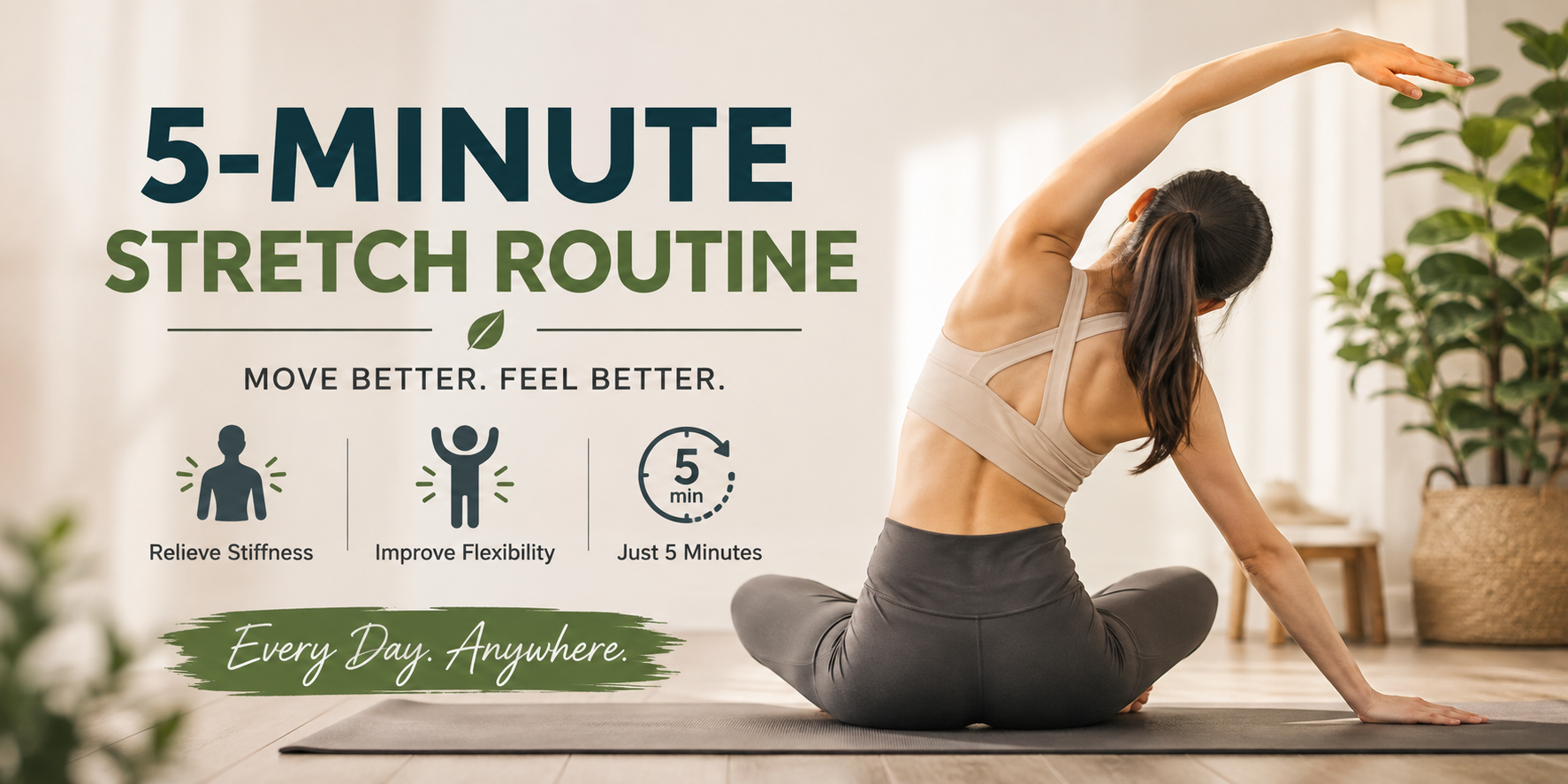
This 5-minute stretch routine combines simple stretching exercises and mobility movements for the neck, shoulders, upper back, hips, hamstrings, calves, and ankles.
It requires no equipment and can be done at home, at work, or almost anywhere you have enough room to stand safely.
Research suggests that a single stretching session can produce a small short-term improvement in range of motion, while regular stretching over time can lead to greater flexibility improvements.
A 5-minute full-body stretching routine can be a practical way to move stiff areas through comfortable ranges of motion. Stretch slowly, breathe normally, and stop if you experience sharp, shooting, or unusual pain.
Why Does Your Body Feel Stiff?
Feeling stiff can be especially common after spending a long time sitting or staying in the same position.
When you’re inactive for extended periods, your joints and muscles aren’t moving through as many different positions as they normally would. A short movement break can help you get your body moving again.
Stretching is one option for improving flexibility and range of motion. Research involving 47 studies found that an acute stretching session produced small improvements in range of motion across many tests.
However, not every type of stiffness is caused by a lack of flexibility.
If stiffness is severe, persistent, unexplained, or accompanied by pain or other unusual symptoms, stretching may not be the right solution. Consider speaking with a qualified healthcare professional.
What Is the Best 5-Minute Stretch Routine?
For general stiffness, a simple full-body stretching routine can target several commonly tight areas rather than focusing on one muscle group.
Your 5-minute stretching plan
| Time | Stretching exercise | Main target |
|---|---|---|
| 0–1 minute | Neck turns and shoulder rolls | Neck and shoulders |
| 1–2 minutes | Chest and upper-back opener | Chest and upper back |
| 2–3 minutes | Standing hip flexor stretch | Hips and thighs |
| 3–4 minutes | Standing hamstring stretch | Back of thighs |
| 4–5 minutes | Standing calf stretch | Calves and ankles |
You can use this quick stretching routine:
- In the morning
- After sitting for a long time
- During a work break
- After driving
- Before an evening shower
- As part of a daily mobility routine
1. Neck and Shoulder Stretch — 1 Minute
Start seated or standing with your back comfortable and upright.
- Relax your shoulders.
- Slowly turn your head toward the right.
- Return to the center.
- Slowly turn toward the left.
- Repeat several times.
- Finish with gentle shoulder rolls.
Keep every movement slow and controlled.
Don’t force your neck into a deep stretch or rapidly rotate it.
What does this stretch target?
This gentle mobility exercise targets the neck and shoulders, making it a useful movement break after prolonged computer or phone use.
Tip: Keep your jaw relaxed and continue breathing normally.
2. Chest and Upper-Back Stretch — 1 Minute
Stand with your feet approximately hip-width apart.
- Place your hands behind your body if comfortable.
- Gently draw your shoulders backward.
- Lift your chest slightly.
- Avoid excessive arching through your lower back.
- Hold for several comfortable breaths.
- Relax and repeat.
If clasping your hands is difficult, simply place your hands behind your hips.
What does this stretch target?
This movement focuses on the chest, shoulders, and upper back.
It can be particularly convenient after spending hours sitting at a desk or looking down at a phone.
3. Hip Flexor Stretch — 1 Minute
Standing hip stretches can be useful after long periods of sitting.
Start in a comfortable split stance with one foot forward and the other behind you.
- Bend your front knee slightly.
- Keep your upper body upright.
- Gently shift your hips forward.
- Stop when you feel a comfortable stretch around the front of the rear hip.
- Hold for about 30 seconds.
- Switch sides.
Don’t force your hips forward or excessively arch your lower back.
Why stretch the hip flexors?
Your hip flexors remain in a shortened position while your hips are bent during sitting. A gentle hip flexor stretch introduces movement in the opposite direction.
This doesn’t mean sitting automatically causes tight hip flexors in everyone, but it can make hip mobility work a useful addition to a movement break.
4. Hamstring Stretch — 1 Minute
The hamstrings are the muscles along the back of your thighs.
To perform a simple standing hamstring stretch:
- Stand near a stable surface if you need balance.
- Place one heel slightly forward.
- Keep the extended leg comfortably straight without locking the knee.
- Bend slightly through the opposite knee.
- Hinge forward from your hips.
- Keep your back relatively neutral.
- Hold for about 30 seconds.
- Switch sides.
You should feel a gentle pulling sensation along the back of your thigh.
Avoid bouncing or forcing yourself to touch your toes.
Research supports stretching as an effective way to improve range of motion, including in the hamstrings.
5. Calf and Ankle Stretch — 1 Minute
Finish your 5-minute stretching routine with a standing calf stretch.
- Face a wall or stable surface.
- Place your hands on the wall.
- Step one foot backward.
- Keep the back heel comfortably on the floor.
- Bend your front knee.
- Slowly move your body toward the wall.
- Hold for approximately 30 seconds.
- Switch sides.
You should feel a gentle stretch through the calf of the back leg.
This movement also takes the ankle through a comfortable range of motion.
How Long Should You Hold a Stretch?
For this quick routine, approximately 30 seconds per side works well for stretches performed separately on each side.
You don’t need to push as hard as possible.
The goal is to create a comfortable stretching sensation while maintaining controlled movement and normal breathing.
Recent research involving 189 studies and 6,654 adults found that static stretching improved flexibility. The review reported that flexibility improvements were maximized around a cumulative four minutes of static stretching per session, although individual responses can vary.
That doesn’t mean you need to hold every stretch for four minutes. Your five-minute routine can include several different mobility and flexibility exercises.
Can 5 Minutes of Stretching Improve Flexibility?
Yes, five minutes can be a useful starting point, but consistency matters more than one session.
A single stretching session can temporarily improve range of motion, while regular stretching programs can produce larger improvements over time. A meta-analysis of 77 studies found that long-term stretch training significantly improved range of motion compared with controls.
Think of a five-minute routine as a simple daily movement habit—not a quick fix for every type of stiffness.
Should You Stretch Every Day?
Gentle stretching can be included in a daily movement routine when it feels comfortable.
You don’t need to perform an intense flexibility workout every day.
A practical approach is:
5 minutes: Quick daily stretching or mobility break
10 minutes: More complete flexibility session
Before exercise: Favor dynamic movement and an appropriate warm-up
After exercise: Gentle static stretching can be included if comfortable
Research supports regular stretch training for improving range of motion over time.
Is It Better to Stretch Before or After Exercise?
The answer depends on your goal.
Before exercise
Use dynamic movements and a gradual warm-up to prepare your body for activity.
Long static stretches immediately before certain high-intensity activities may temporarily affect performance. Research has generally found smaller performance effects with shorter static stretches, while longer static stretching can have greater immediate effects.
After exercise
Gentle static stretching can be included as part of a cool-down or flexibility routine.
During the day
If your goal is simply to break up prolonged sitting and move more, you don’t need to wait for a workout.
A short desk stretching routine can be a convenient way to add movement throughout the day.
Stretching vs. Mobility: What’s the Difference?
Although the terms are often used together, stretching and mobility aren’t exactly the same thing.
Stretching generally focuses on creating a lengthening or stretching sensation in a muscle or surrounding tissue.
Mobility refers more broadly to how well you can actively control movement through a joint’s available range.
For example, a hamstring stretch may help increase comfortable range of motion, while controlled leg movements help you actively use that range.
A balanced flexibility and mobility routine can include both.
Importantly, stretching isn’t the only way to improve range of motion. Research comparing resistance training and stretching has found that both can improve flexibility under some conditions.
Can Stretching Reduce Stiffness Immediately?
Stretching may make movement feel easier by temporarily increasing range of motion, but it shouldn’t be presented as a guaranteed treatment for stiffness.
A 2023 systematic review and meta-analysis found small acute improvements in range of motion following a single stretching session.
Other research also suggests that acute flexibility improvements aren’t necessarily unique to stretching, with other warm-up approaches producing similar short-term changes in some studies.
So if your body feels stiff after sitting for hours, a five-minute stretch and movement break may be worthwhile—but walking, changing positions, and other forms of movement can also be useful.
5-Minute Morning Stretch Routine
If you prefer exercising or stretching after waking up, use this simple sequence:
Minute 1: Neck turns and shoulder rolls
Minute 2: Chest and upper-back opener
Minute 3: Hip flexor stretch
Minute 4: Hamstring stretch
Minute 5: Calf and ankle stretch
Move gently, especially if you have just gotten out of bed.
The goal isn’t to achieve maximum flexibility first thing in the morning. It’s simply to get your body moving comfortably.
5-Minute Stretch Routine for Desk Workers
Sitting at a desk for hours can make a quick movement break especially convenient.
Try:
- Neck turns for gentle neck mobility
- Shoulder rolls for the shoulders
- Chest opening for the upper body
- Hip flexor stretching after sitting
- Hamstring stretching for the back of the legs
- Calf and ankle movements after prolonged sitting
If possible, follow your stretch break with a short walk.
Remember that stretching should complement—not replace—regular physical activity.
What Should a Good Stretch Feel Like?
A normal stretch should feel like mild to moderate tension or pulling in the target area.
It shouldn’t feel like:
- Sharp pain
- Shooting pain
- Burning pain
- Numbness
- Tingling
- Sudden weakness
- Joint instability
If these symptoms occur, stop the exercise instead of trying to stretch through them.
Does a deeper stretch work better?
Not necessarily.
More intense stretching isn’t automatically more effective. The goal is controlled, comfortable movement that fits your current flexibility and mobility.
Common Stretching Mistakes to Avoid
1. Bouncing during a stretch
Use slow, controlled movements instead of repeatedly bouncing at the end of your range.
2. Holding your breath
Continue breathing normally throughout your stretching exercises.
3. Stretching through pain
A stronger sensation doesn’t necessarily mean a better result.
4. Forcing flexibility
Don’t compare your flexibility with someone else’s. Your comfortable range of motion is individual.
5. Stretching only once
A single session can provide short-term range-of-motion benefits, but regular stretching is more relevant when your goal is long-term flexibility.
6. Assuming every ache needs stretching
Not all stiffness or pain is caused by limited flexibility.
If stretching makes symptoms worse, stop and seek appropriate professional advice.
Who Should Be Careful With Stretching?
Gentle stretching is appropriate for many healthy adults, but individual circumstances matter.
Speak with a qualified healthcare professional before starting specific exercises if you have:
- A recent injury
- Significant joint pain
- Unexplained swelling
- Neurological symptoms
- A known joint or connective-tissue disorder
- Another medical condition that affects movement
Stop exercising and seek appropriate medical advice if movement causes severe or unusual symptoms.
This article provides general fitness information and isn’t a substitute for personalized medical advice.
How Can You Make a 5-Minute Stretching Habit Stick?
The easiest way to maintain a daily stretching routine is to connect it with something you already do.
Try your five-minute routine:
- After waking up
- After finishing work
- During your lunch break
- After a long drive
- After prolonged computer use
- Before your evening shower
- After a workout
Set a five-minute timer and move through the sequence without rushing.
You don’t need expensive equipment, a gym membership, or an advanced yoga routine.
Five minutes. Five simple movements. One easy daily habit.
Frequently Asked Questions About Stretching
What is the best 5-minute stretch routine for a stiff body?
A useful five-minute routine can combine neck and shoulder mobility, a chest opener, hip flexor stretching, hamstring stretching, and calf stretching. This approach covers several major areas of the body without requiring equipment. Perform each movement gently and stay within a comfortable range of motion.
Can 5 minutes of stretching make a difference?
Yes. A short stretching session can produce a small temporary improvement in range of motion. However, long-term flexibility gains depend more on consistent stretch training than one isolated session.
How long should you hold a stretch?
For this beginner-friendly routine, around 30 seconds per side is a practical starting point for individual static stretches. You don’t need to force the movement or hold a stretch until it becomes painful.
Is stretching good for flexibility?
Yes. Research supports stretching as an effective method for improving range of motion and flexibility. A 2025 systematic review found positive effects from both acute and chronic static stretching in adults.
Should you stretch every day?
Gentle stretching can be part of a daily movement routine if it feels comfortable. For long-term flexibility, regular stretching is more important than occasional intense sessions.
Is morning stretching good for a stiff body?
A gentle morning stretching routine can be a convenient way to move after sleeping. Start slowly rather than immediately forcing deep stretches.
What are the best stretches for tight muscles?
Useful beginner stretches include hamstring stretches, hip flexor stretches, calf stretches, chest stretches, and gentle shoulder mobility. The right exercise depends on which area feels restricted and whether stretching is appropriate for the underlying problem.
Should stretching hurt?
No. Mild tension or pulling can be normal, but sharp, shooting, burning, or unusual pain isn’t something you should push through.
Is stretching or mobility better?
Neither is universally better. Stretching can help improve flexibility and range of motion, while mobility exercises emphasize controlled movement through available ranges. Combining both can create a more complete movement routine.
Your 5-Minute Full-Body Stretching Reset
You don’t need an hour-long workout to give your body a movement break.
When you feel stiff:
Stand up.
Take a breath.
Move slowly.
Stretch comfortably.
Spend five minutes working through your neck, shoulders, upper back, hips, hamstrings, calves, and ankles.
This 5-minute stretch routine won’t replace strength training, cardiovascular exercise, or professional medical care when needed. But it can be a simple way to add stretching, mobility, and movement to your everyday routine.
The biggest benefit may be how easy it is to repeat.
Five minutes today can be the start of a more consistent flexibility and mobility habit tomorrow.