
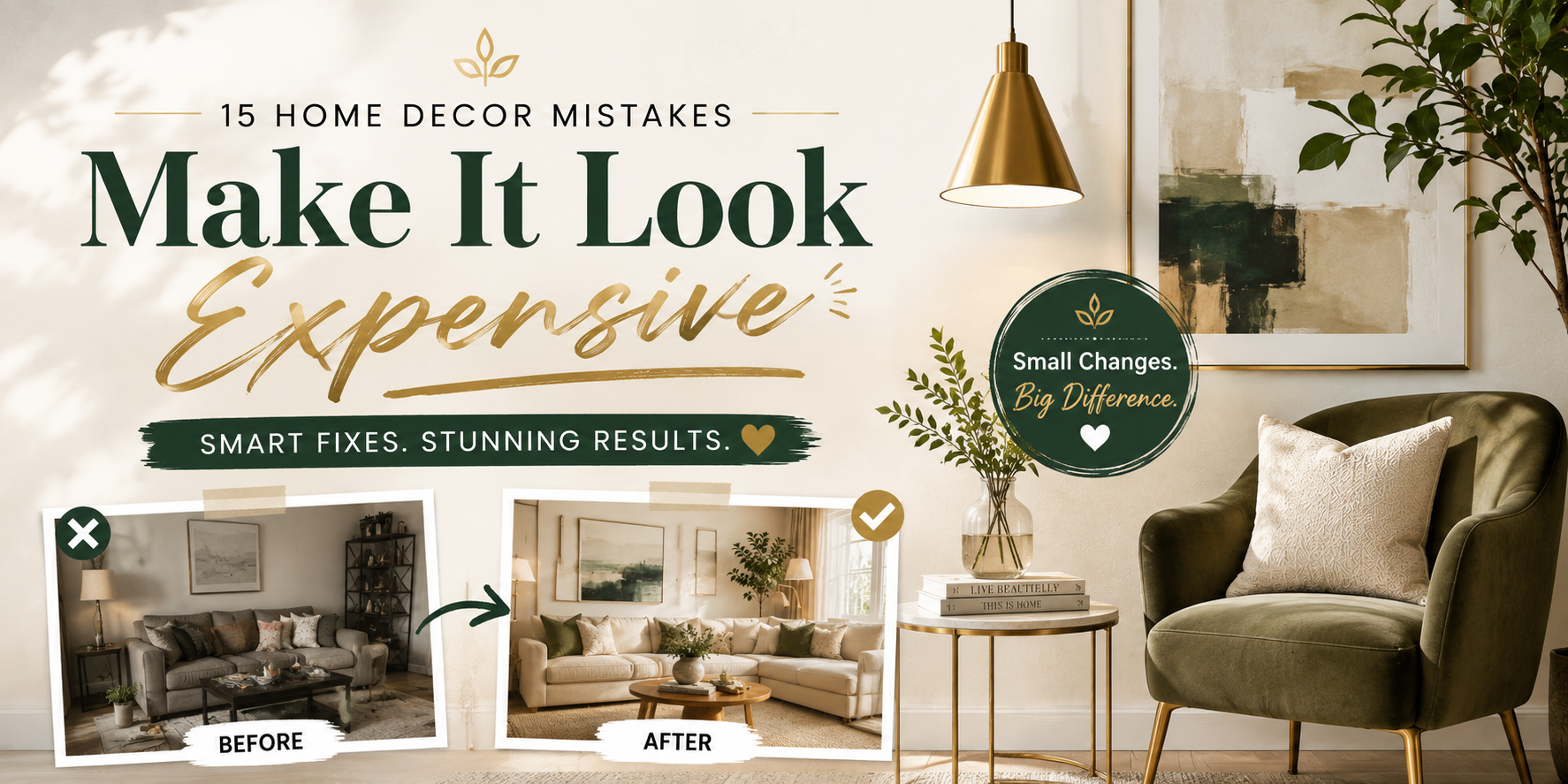
What Makes a House Look Cheap?
A home can look cheap even when you have spent a lot on furniture and decor. The most common reasons are poor furniture placement, undersized rugs, harsh lighting, short curtains, excessive clutter, mismatched proportions, overly coordinated furniture, and too many trendy accessories.
The good news is that making your house look expensive is usually more about thoughtful styling than spending more money. Designers continue to emphasize proportion, lighting, texture, editing, and intentional details when creating polished interiors.
If your home looks nice but still feels unfinished, these common decorating mistakes could be the reason.
1. Using a Matching Furniture Set
Buying an entire living room furniture set from the same collection may seem like an easy way to create a coordinated look. However, when the sofa, coffee table, side tables, TV unit, and other pieces all have the same finish and design, the room can feel generic or showroom-like.
What to do instead
Create a more collected interior by mixing complementary:
- Furniture styles
- Wood tones
- Textures
- Materials
- Shapes
- Vintage and modern pieces
Your furniture should coordinate without looking identical.
Current interior-design guidance continues to flag overly matched furniture as a common reason rooms can lose personality.
Best rule: Match the overall style, not every individual piece.
2. Choosing a Rug That Is Too Small
An area rug that is too small can make an entire living room look disconnected.
When the rug floats underneath the coffee table without properly anchoring the seating area, the sofa and chairs can appear randomly placed.
How to choose the right rug size
Measure your furniture arrangement before shopping for a rug. Ideally, the rug should visually connect the major seating pieces, with the appropriate furniture legs positioned on the rug according to the room layout.
Don’t choose a rug simply because it is cheaper or easier to fit.
Designers continue to identify undersized rugs as one of the decorating mistakes that can make a room feel incomplete.
3. Hanging Curtains Too Low or Too Short
Window treatments have a surprisingly strong effect on how expensive a room looks.
Curtains that are too short or installed directly around the window frame can make walls and windows appear smaller. Properly scaled curtains can create a taller, more finished appearance.
How should curtains be hung?
In many rooms, installing the rod higher and wider than the window and using floor-length curtains can enhance the sense of height and proportion. However, the exact placement should depend on ceiling height, window size, architecture, fabric, and practicality.
For an elevated home decor look, pay attention to:
- Curtain length
- Rod width
- Fabric quality
- Fullness
- Color
- Relationship to the wall and window
Strategic window treatments are also frequently recommended as a relatively affordable way to make a home feel more polished.
4. Relying on One Harsh Ceiling Light
Lighting can completely change how your home decor looks.
A single bright ceiling light often creates harsh shadows and makes a room feel flat. Even beautiful furniture can lose its impact under poor lighting.
How do you make a room look expensive with lighting?
Use layered lighting instead of relying on one fixture.
Combine:
- Ambient lighting for general illumination
- Task lighting for reading, working, or cooking
- Accent lighting for artwork, plants, shelves, or architectural features
Add floor lamps, table lamps, wall lights, or dimmers where appropriate.
Current designer advice increasingly favors layered lighting because it creates a warmer and more flexible atmosphere.
5. Putting Too Much Decor on Every Surface
More home decor does not automatically mean a more luxurious home.
When every shelf, table, countertop, and console is filled with small objects, the room can quickly feel cluttered.
Try this simple home decor trick
Remove several items from one surface and leave more empty space around the pieces you actually love.
Then style the remaining objects using differences in:
- Height
- Shape
- Texture
- Color
- Material
A few well-selected accessories can create more visual impact than dozens of small decorations.
Current design advice also emphasizes editing visual clutter and choosing fewer, more meaningful pieces.
6. Buying Furniture That Is the Wrong Size
One of the biggest interior design mistakes is ignoring scale and proportion.
A tiny sofa can look lost in a large living room, while an oversized sectional can overwhelm a small space. The same problem applies to coffee tables, lamps, artwork, dining tables, and accent chairs.
What is scale and proportion in interior design?
Scale refers to how an object’s size relates to the room. Proportion refers to how its dimensions relate to other objects within the space.
Before buying furniture, measure:
- Room dimensions
- Ceiling height
- Doorways
- Windows
- Furniture dimensions
- Walking paths
- Clearance around tables and seating
Good proportions can make affordable furniture look much more sophisticated.
7. Pushing All the Furniture Against the Walls
Putting every piece of furniture against a wall may seem like the best way to make a room feel larger, but it can sometimes create an awkward, disconnected layout.
Instead, think about creating conversation zones.
Try positioning seating around a rug or coffee table when the room allows it. In larger spaces, floating furniture away from the walls can make the room feel more intentional and comfortable.
The goal is not simply to maximize empty floor space. It is to create a layout that works for how you actually use the room.
8. Using Too Many Colors and Finishes
A stylish home does not have to be completely monochromatic, but too many unrelated colors and finishes can make a space feel chaotic.
Choose a simple color palette and repeat selected materials throughout the room.
A simple home color palette can include:
- 1–2 dominant colors
- 1–2 supporting colors
- Neutral foundation tones
- A few accent colors
- Repeated materials or finishes
For example, warm white, natural wood, muted green, woven textures, and aged metal can work together without making everything look identical.
Remember: A cohesive home does not mean every room has to match.
9. Following Every Home Decor Trend
Trendy home decor can be fun, but building an entire room around short-lived trends can make the space feel dated quickly.
Current design coverage continues to recommend balancing trends with timeless elements rather than allowing yearly trends to dictate an entire interior.
Use trends on easy-to-change items such as:
- Throw pillows
- Small decorative objects
- Artwork
- Lamps
- Vases
- Textiles
Be more selective with expensive or permanent decisions such as:
- Flooring
- Cabinetry
- Major furniture
- Permanent wall treatments
- Expensive fixtures
Your home should reflect your personality—not just the latest social media trend.
10. Using Cheap-Looking Hardware
Small details can have a big effect on the overall appearance of your home.
Outdated cabinet knobs, worn handles, mismatched pulls, and inexpensive-looking fixtures can make otherwise attractive furniture feel less polished.
An easy upgrade
Consider replacing hardware on:
- Kitchen cabinets
- Bathroom vanities
- Dressers
- Sideboards
- Storage cabinets
You don’t necessarily need expensive hardware. Focus on good proportions and a finish that complements your existing interior.
11. Leaving Cables and Clutter Visible
Visible charging cables, remote controls, paperwork, packaging, and miscellaneous items can instantly make a room feel less organized.
A stylish home does not have to be minimalist. It simply needs smart storage for everyday clutter.
Easy organization ideas
Use:
- Decorative baskets
- Closed cabinets
- Storage ottomans
- Cable-management boxes
- Drawer organizers
- Decorative trays
- Built-in storage
Decluttering and organization remain some of the simplest ways to make a home feel more polished without a major renovation.
12. Using Artwork That Is Too Small
A tiny artwork placed alone on a large empty wall can look out of proportion.
Instead of immediately buying expensive oversized art, consider creating more visual weight by:
- Grouping smaller prints
- Creating a gallery wall
- Using larger frames
- Pairing artwork with furniture
- Layering artwork with a console or shelf
The goal is to make the artwork feel appropriately scaled to the wall and surrounding furniture.
13. Using Too Many Shiny or Artificial Finishes
Glossy finishes and metallic accents are not automatically cheap-looking. The problem occurs when a room has too many reflective or artificial-looking materials without enough texture.
Balance shiny surfaces with:
- Natural wood
- Linen
- Cotton
- Wool
- Ceramic
- Stone
- Woven materials
- Matte finishes
- Brushed or aged metals
Texture gives a room depth and prevents the space from feeling flat.
14. Buying Home Decor Without a Plan
Impulse shopping is one of the easiest ways to create a disconnected interior.
A decorative vase might look beautiful in a store but feel completely wrong once you bring it home.
Before buying something, ask:
Does this improve the room’s color, texture, scale, function, or personality?
If it does none of these things, you may not need it.
Instead of filling every empty corner, identify the areas that genuinely need improvement.
15. Making Every Room Look Completely Different
Your bedroom does not have to look exactly like your living room. Different spaces should have their own personalities.
However, repeating a few design elements can make the entire house feel cohesive.
You might repeat:
- Similar wood tones
- Related neutral colors
- Complementary metal finishes
- Similar lighting temperatures
- Recurring accent colors
- Consistent flooring
This creates a natural visual connection between rooms without making your home feel overly coordinated.
How Can I Make My House Look Expensive on a Budget?
You can make your house look expensive without buying luxury furniture or renovating the entire space. Start by decluttering, improving furniture placement, choosing the right rug size, upgrading lighting, hanging curtains properly, hiding cables, adding texture, and replacing dated hardware.
Recent 2026 design advice consistently emphasizes that an expensive-looking home is more about curation, proportion, lighting, restraint, and thoughtful details than the price of individual items.
Try these affordable home decor upgrades:
- Declutter surfaces.
- Rearrange your furniture.
- Add layered lighting.
- Upgrade cabinet hardware.
- Improve curtain placement.
- Choose a properly sized rug.
- Hide visible cables.
- Add natural textures.
- Reframe existing artwork.
- Introduce meaningful vintage or secondhand pieces.
You may be surprised by how much difference these small changes make.
What Makes a Home Look Luxurious?
A luxurious home generally feels intentional, balanced, comfortable, cohesive, and personal. Good proportions, layered lighting, quality-looking materials, restrained decor, well-chosen colors, thoughtful window treatments, and meaningful accessories often create a more sophisticated appearance than simply filling a room with expensive products.
A high-end look is not necessarily about having the most expensive sofa or designer accessories.
Consider the difference between:
Expensive but poorly styled:
Large sofa + tiny rug + harsh lighting + cluttered coffee table.
Affordable but well styled:
Appropriately sized sofa + large enough rug + layered lighting + edited accessories + cohesive colors.
The second room can easily feel more polished.
10 Easy Ways to Make Your Home Look More Expensive
If you want the biggest visual improvement without spending a fortune, focus on these areas first:
1. Declutter
Remove unnecessary objects and create breathing room.
2. Improve the lighting
Add lamps instead of relying exclusively on overhead lighting.
3. Fix your rug size
Make sure the rug anchors the main furniture arrangement.
4. Upgrade curtains
Use properly scaled, floor-length window treatments where appropriate.
5. Mix furniture
Avoid making every piece look like it came from one collection.
6. Add texture
Use wood, linen, cotton, wool, ceramic, stone, and woven materials.
7. Hide cables
Organize technology and everyday clutter.
8. Upgrade small hardware
Replace outdated knobs and pulls.
9. Choose meaningful decor
Use pieces that tell your story instead of generic accessories.
10. Edit before you buy
Sometimes removing three things improves a room more than purchasing three new things.
What Should You Fix First If Your Home Looks Cheap?
Start with the issues that have the greatest visual impact: clutter, furniture layout, rug size, lighting, curtains, and scale. These changes can often improve a room without requiring a complete redesign.
|
Priority |
Decorating Problem |
Simple Solution |
|
1 |
Too much clutter |
Remove unnecessary items |
|
2 |
Poor furniture arrangement |
Rearrange the existing furniture |
|
3 |
Small rug |
Use a better-sized rug |
|
4 |
Harsh lighting |
Add lamps or dimmable lighting |
|
5 |
Short curtains |
Rehang or replace them |
|
6 |
Visible cables |
Use cable management |
|
7 |
Dated hardware |
Replace key handles |
|
8 |
Poorly scaled artwork |
Regroup or reframe it |
|
9 |
Flat textures |
Add textiles and natural materials |
|
10 |
Too many trends |
Keep trend pieces limited |
How Can I Make a Small House Look More Expensive?
In a small home, avoid filling the room with too many small pieces of furniture and decorative objects. Instead, focus on good proportions, visual simplicity, strategic lighting, appropriate rugs, storage, and a few impactful design elements.
Interestingly, current designers are moving away from the idea that every small room should use tiny furniture and plain white walls. Larger rugs, full-length drapery, strong lighting, and fewer but more impactful decorative elements can sometimes create a stronger sense of space.
For a small living room:
- Choose furniture that fits the room without overcrowding it.
- Use a rug large enough to connect the seating area.
- Keep pathways clear.
- Use mirrors strategically.
- Reduce small decorative objects.
- Add layered lighting.
- Use vertical space for storage and artwork.
Do Expensive Furniture and Decor Always Make a House Look Expensive?
No. Expensive furniture can still look cheap when the surrounding decor, scale, lighting, layout, or proportions are wrong. Affordable furniture can look sophisticated when it is properly scaled, thoughtfully arranged, well maintained, and combined with cohesive colors, textures, and lighting.
This is why visual quality and price are not the same thing.
Before replacing an expensive-looking problem with an expensive purchase, ask whether the issue can be fixed through better placement, decluttering, lighting, or styling.
5-Minute Home Decor Audit
Want to know what is making your room look unfinished?
Stand in the doorway and look at the room as if you were seeing it for the first time.
Ask:
Is anything too small or too large?
Check the rug, sofa, coffee table, artwork, lamps, and accessories.
Is there too much clutter?
Remove anything that is unnecessary or doesn’t contribute to the room.
Is the lighting too harsh?
Turn off the main ceiling light and test your lamps individually.
Do the curtains look properly fitted?
Check their height, width, length, and overall fullness.
Does the room have personality?
Add something meaningful instead of another generic decoration.
Does the furniture layout make sense?
Can people comfortably sit, talk, walk, and use the room?
Does everything visually belong together?
Look for random colors, finishes, patterns, or furniture styles.
Fixing just two or three major issues can make a noticeable difference.
Frequently Asked Questions About Home Decor Mistakes
What is the biggest mistake that makes a house look cheap?
Some of the biggest decorating mistakes are poor furniture proportions, undersized rugs, excessive matching, clutter, harsh lighting, and poorly fitted curtains. These issues can make even expensive furniture and decor feel disconnected or unfinished.
How can I make my house look expensive without spending money?
Start with free changes: declutter, rearrange furniture, improve the layout, remove unnecessary accessories, organize visible cables, and create more breathing room. Then consider affordable upgrades such as lighting, curtains, hardware, and artwork.
What makes a living room look cheap?
A living room can look cheap when furniture is poorly scaled, the rug is too small, lighting is harsh, clutter covers every surface, furniture is overly matched, or the room lacks texture and personality.
Does clutter make a home look cheap?
Excessive clutter can make a home feel chaotic and less polished. Removing unnecessary items and leaving more negative space can create a cleaner and more intentional appearance.
Do matching furniture sets look cheap?
Not necessarily, but an entire matching furniture collection can make a room feel generic. Mixing complementary styles, materials, finishes, and textures can create a more personalized and collected appearance.
What lighting makes a house look expensive?
Layered lighting generally creates a more sophisticated and comfortable atmosphere than relying on one overhead fixture. Combine ambient, task, and accent lighting based on how you use the room.
Should curtains touch the floor?
Floor-length curtains often create a polished appearance in living rooms and bedrooms, provided the length works with the room’s architecture and practical needs. Curtain placement should also consider ceiling height, window size, fabric, and installation.
Does a small rug make a room look cheap?
An undersized rug can make furniture appear disconnected and cause a room to feel incomplete. Choose a rug that properly anchors the main seating arrangement and works with the room’s proportions.
How do I make my living room look expensive?
Focus on the basics first: correct the furniture layout, use a properly sized rug, improve lighting, hang curtains thoughtfully, reduce clutter, add texture, and choose artwork and accessories that complement the room.
Should every room in a house match?
No. Each room can have its own style and personality. Repeating a few colors, materials, finishes, or design elements throughout the house can create cohesion without making every room identical.
What home decor should I remove first?
Start with broken, duplicated, outdated, overly trendy, random, or unnecessary pieces. Removing visual clutter can make the remaining furniture and decor look more intentional.
Final Takeaway
Your home does not need designer furniture or a huge decorating budget to look stylish and expensive.
The biggest home decor mistakes are often simple: undersized rugs, poorly fitted curtains, harsh lighting, excessive clutter, bad furniture proportions, matching furniture sets, visible cables, random colors, trend overload, and generic accessories.
The solution is not always to buy more.
Measure before buying. Edit before adding. Layer instead of matching. Mix textures. Improve your lighting. Create breathing room. Choose pieces that have meaning.
The most expensive-looking homes are rarely the ones filled with the most expensive things. They are the homes where the furniture, lighting, colors, textures, and accessories work together intentionally.