





AI Search vs Google: What Is Changing?
Traditional Google Search is not dying, but the way people search for information is changing quickly. Instead of entering short keywords and scanning a list of links, users can increasingly ask detailed questions and receive AI-generated answers, summaries, comparisons, and follow-up responses.
Google itself is driving this change through AI Overviews and AI Mode, while AI-powered platforms such as ChatGPT, Gemini, and Perplexity are creating alternative search experiences.
As of 2026, the bigger trend is not AI search replacing Google. It is Google Search becoming an AI-powered search engine while AI assistants become another way to discover information.
Google reported in June 2026 that AI Overviews had more than 2.5 billion monthly active users, while AI Mode had surpassed 1 billion monthly users. Google also said AI-powered Search was contributing to record query volumes.
So, is traditional search dying?
Not exactly. Search is evolving from a list of links into a more conversational, AI-powered information experience.
What Is the Difference Between AI Search and Google Search?
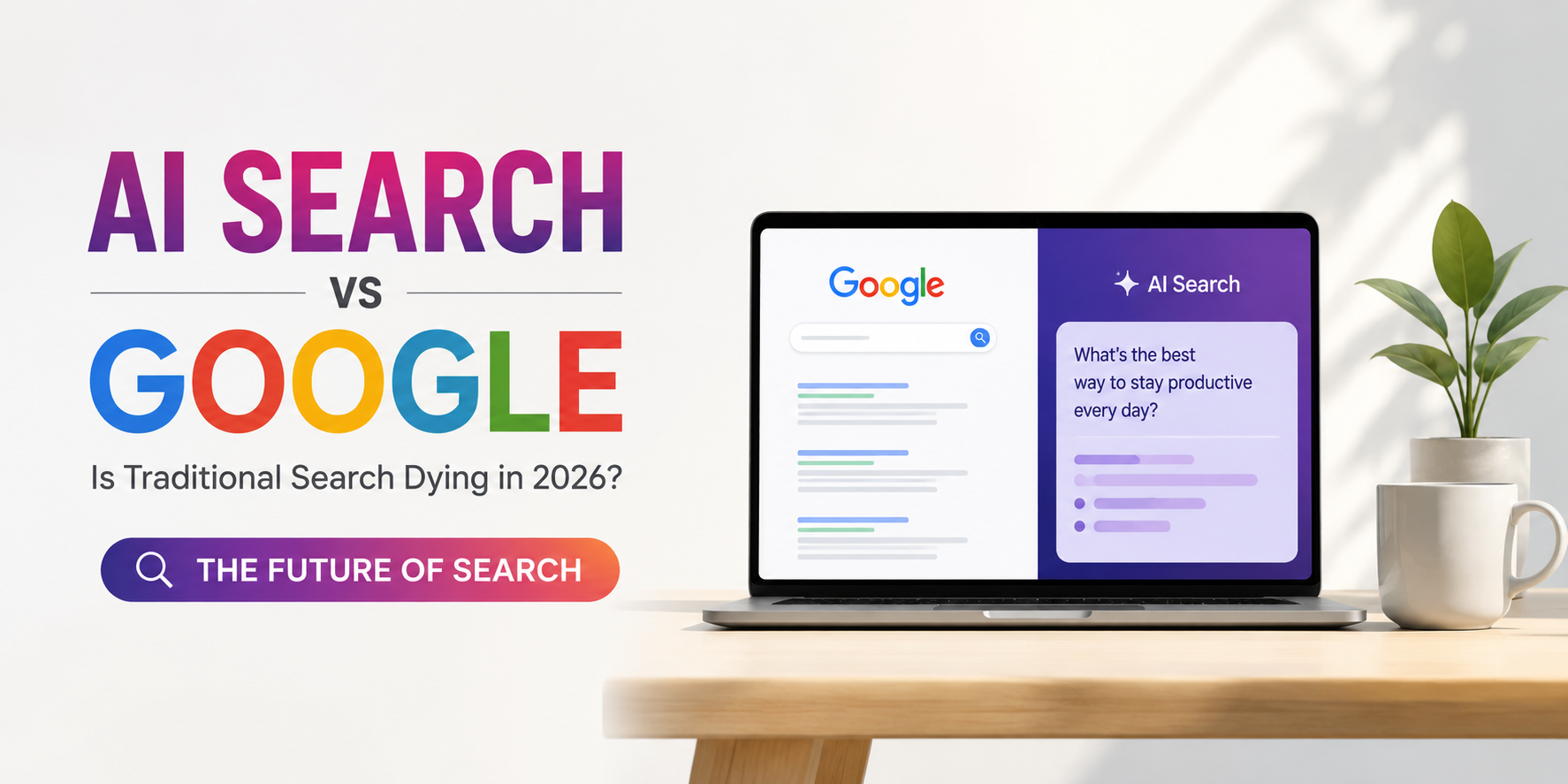
Traditional Google Search primarily retrieves and ranks webpages that match a user’s query. AI search adds another layer: it interprets the question, gathers relevant information, synthesizes it, and presents a conversational answer.
The distinction is becoming less obvious because Google now combines traditional search results with generative AI.
|
Traditional Google Search |
AI Search |
|
Shows ranked webpages |
Generates synthesized answers |
|
Often uses short keywords |
Handles detailed questions |
|
Users compare several pages |
AI can summarize multiple sources |
|
Strong for navigation |
Strong for research and exploration |
|
User evaluates information manually |
AI performs some initial synthesis |
|
Query → results |
Question → answer → follow-up |
Google’s AI Mode is specifically designed to handle more complex and conversational searches while continuing to connect users with web content.
Is Google Search Being Replaced by AI?
No. Google is integrating artificial intelligence into Search rather than replacing Search with a completely separate product. AI Overviews and AI Mode combine Google’s search infrastructure with generative AI, allowing users to receive conversational answers while still discovering websites and other sources.
Google’s 2026 updates make this strategy clear.
AI Mode surpassed 1 billion monthly active users only about a year after launch, while Google says AI-powered features are driving increased Search usage.
The likely transition therefore looks less like:
Google → replaced by AI
and more like:
Google Search → AI-powered Google Search
At the same time, independent AI search tools are creating another path to information discovery.
Why Is AI Search Becoming So Popular?
The biggest advantage of AI search is convenience.
A traditional search might look like:
best laptop for video editing
An AI search query could be:
I edit 4K video several hours a day, travel frequently, have a budget of ₹1.5 lakh, and want a quiet laptop. Which models should I compare?
The second question contains more context and constraints. An AI search engine can use that context to organize the answer and continue the conversation.
AI search is particularly useful for:
- Complex questions
- Product comparisons
- Research
- Planning
- Summarization
- Explanations
- Brainstorming
- Multi-step tasks
- Follow-up questions
- Multimodal searches
Google has reported that people are increasingly asking longer and more complex questions through AI-powered Search. In India, Google previously reported that early AI Mode users were asking queries two to three times longer than traditional searches.
Is Traditional Google Search Still Useful?
Absolutely. Traditional Google Search remains valuable when you want a specific website, official document, local business, product page, news source, or multiple original sources. AI answers can save time, but users still often need to visit the underlying webpages to verify information or take action.
Traditional search is particularly useful for:
- Finding an official government website
- Visiting a company’s website
- Comparing product pages
- Reading the full original article
- Checking official documentation
- Finding local businesses
- Verifying statistics
- Reviewing multiple viewpoints
This means AI search does not necessarily eliminate websites.
Instead, AI can become the discovery and interpretation layer sitting between users and the web.
What Are Google AI Overviews?
Google AI Overviews are AI-generated summaries that appear within Google Search for eligible queries. They provide a concise overview of a topic and include links that can help users explore supporting information.
Google has expanded AI Overviews substantially. In 2026, Google reported that the feature had more than 2.5 billion monthly active users worldwide.
This changes the traditional Google search experience.
The old model was:
Search query → ranked links → website
The newer model can be:
Question → AI Overview → supporting sources → follow-up search
Google has also continued adding ways for users to discover original content and preferred sources within AI-powered Search.
What Is Google AI Mode?
Google AI Mode is Google’s more conversational AI search experience for complex questions, deeper research, multimodal searches, and follow-up conversations.
Instead of treating every search as an isolated query, AI Mode is designed to let users continue exploring a subject.
Google says AI Mode can use a query fan-out approach, breaking a complex question into related searches to investigate multiple aspects of a topic.
For example:
Traditional search:
best places to visit Japan
AI Mode:
I have five days in Japan in November, want good food and cultural experiences, don’t want to change hotels more than once, and have a moderate budget. Which itinerary makes the most sense?
The second query requires reasoning across several constraints.
That is exactly the type of search AI is designed to handle.
AI Search vs Google: Which One Is Better?
There is no single winner. The better search method depends on what you are trying to accomplish.
Google Search is often better for:
- Finding a specific website
- Local searches
- Maps and directions
- Product listings
- Official documents
- News websites
- Original sources
- Comparing search results yourself
AI search is often better for:
- Complex questions
- Explanations
- Research
- Comparisons
- Summaries
- Brainstorming
- Planning
- Follow-up questions
- Multi-step problems
The best approach is often both
For important topics, use:
AI for discovery and synthesis → original sources for verification.
This combines the speed of AI with the reliability of checking primary information.
Is AI Search More Accurate Than Google?
AI search is not automatically more accurate than traditional search. AI systems can synthesize information quickly, but they can also misunderstand questions, use weak sources, or generate incorrect information. Traditional search has different risks because users may select unreliable or outdated webpages.
For important decisions involving:
- Health
- Finance
- Legal issues
- Safety
- Major purchases
- Government policies
users should verify important claims using authoritative sources.
Google itself acknowledges that AI search systems can make mistakes and continues to develop methods to improve factuality and source discovery.
The lesson is simple:
AI can accelerate research, but it does not eliminate the need for judgment.
Does AI Search Reduce Website Traffic?
AI search can reduce clicks to traditional search results for some queries because users may get enough information directly from an AI-generated summary. Pew Research Center analyzed 68,879 Google searches from March 2025 and found that users clicked a traditional result on 8% of visits when an AI summary appeared, compared with 15% when no AI summary appeared.
The same study found that only 1% of visits with an AI summary resulted in a click on a link inside the summary.
However, this does not mean websites are becoming irrelevant.
It means the relationship between search visibility and website traffic is changing.
A website can now be:
- Ranked in traditional search
- Cited in an AI answer
- Summarized by an AI system
- Discovered through a recommendation
- Used as a source for further research
without necessarily receiving the same click it would have received from a traditional search result.
Does SEO Still Matter in the Age of AI Search?
Yes. SEO remains important because AI-powered search systems still need reliable, useful, and accessible information to retrieve and reference. Google says its existing SEO fundamentals continue to apply to AI Overviews and AI Mode.
Google’s guidance emphasizes that there are no special technical requirements or special schema markup needed specifically to appear in AI Overviews or AI Mode.
That means the SEO goal is evolving.
Instead of focusing only on:
How do I rank #1 for this keyword?
marketers should also ask:
How can my website become one of the most useful and trustworthy sources for this topic?
Strong SEO in an AI search environment still depends on:
- Useful content
- Search intent
- Crawlability
- Indexability
- Clear structure
- Internal links
- Original information
- Expertise
- Trust
- Good user experience
What Is Answer Engine Optimization (AEO)?
Answer Engine Optimization, or AEO, is the practice of structuring content so search engines and AI answer systems can quickly understand and extract useful answers.
AEO-friendly content often includes:
- Direct answers
- Question-based headings
- Definitions
- Short explanations
- Lists
- Tables
- Step-by-step instructions
- Clear terminology
- Supporting evidence
For example, a page targeting “Is traditional search dying?” should answer that question immediately rather than forcing readers through a long introduction.
A strong answer is:
Traditional search is not dying; it is being transformed by AI. Google is integrating generative AI into Search, while AI assistants are creating new ways to discover and understand information.
The supporting sections can then explain the evidence.
This structure benefits both readers and search systems.
What Is Generative Engine Optimization (GEO)?
Generative Engine Optimization, or GEO, focuses on creating authoritative content that AI systems can understand, retrieve, summarize, and potentially reference.
GEO overlaps heavily with modern SEO and AEO.
Important elements include:
- Clear answers
- Strong topical coverage
- Original research
- First-hand experience
- Reliable sources
- Entity clarity
- Natural language
- Specific examples
- Well-organized information
However, GEO should not be treated as a collection of secret AI-ranking tricks.
Google’s current guidance emphasizes valuable, original content and warns against creating large amounts of low-value content primarily to manipulate AI search visibility.
The best GEO strategy is therefore straightforward:
Create information that is genuinely worth retrieving and citing.
How Should Websites Adapt to AI Search?
Businesses, publishers, and SEO professionals should expand their strategy beyond traditional keyword rankings.
1. Answer the main question quickly
Give readers a direct answer near the top of the page.
2. Match search intent
Understand whether users want information, comparison, navigation, a product, or an action.
3. Cover related questions naturally
Build topical depth instead of creating dozens of thin pages for nearly identical keywords.
4. Add original value
Use:
- Original research
- Expert analysis
- Case studies
- First-hand experience
- Data
- Demonstrations
- Unique examples
5. Cite authoritative sources
Use primary and trustworthy sources for important claims.
6. Strengthen internal linking
Connect related pages so users and search systems can understand your site’s broader topic coverage.
7. Keep information fresh
Update statistics, product information, policies, examples, and other time-sensitive content.
8. Prioritize people
Readable content is useful for both humans and AI systems.
Google’s 2026 guidance continues to emphasize original, useful, people-first content and firsthand perspectives.
Will ChatGPT Replace Google Search?
ChatGPT is unlikely to replace every function of Google Search. AI assistants are becoming important tools for research, explanations and conversational discovery, while Google continues to provide web search, local results, shopping, maps and other specialized experiences.
The bigger trend is search fragmentation.
People can now discover information through:
- Google Search
- Google AI Mode
- Google AI Overviews
- ChatGPT
- Gemini
- Perplexity
- YouTube
- Social platforms
- Marketplaces
- Maps
- Specialized databases
Search is therefore becoming less like one destination and more like an ecosystem of information-discovery tools.
Why Is the Web Still Important for AI Search?
There is an important paradox:
The better AI answers become, the more valuable high-quality source material becomes.
AI systems need information to synthesize. Search engines need webpages to retrieve. Users need original sources when they want evidence, detail, or verification.
Google continues to emphasize helping users discover original content and websites through AI-powered Search.
So the web is not necessarily disappearing.
Its role is changing.
Instead of being the destination for every search, a webpage may become the source behind an answer, recommendation, comparison, or research journey.
How Is AI Changing the Way People Search?
Traditional search usually treats each query as a separate interaction.
AI search makes the process conversational.
For example:
User: What are the best cities to visit in Japan?
AI: Here are five options.
User: Which is best in November?
AI: Kyoto and Tokyo are strong choices for different reasons.
User: I only have five days and don’t want to change hotels often.
AI: Kyoto may be the better base because…
The user no longer needs to create a completely new search query for every step.
Google has reported that its AI-powered Search features are driving longer, more complex and more conversational searches.
Common Myths About AI Search and Google
Myth 1: AI Search Means Websites Are Dead
False. AI systems still use web content, and Google continues to connect AI-generated responses with websites and original sources.
Myth 2: SEO Is Dead
False. Google continues to apply core SEO principles to AI-powered Search. Crawlability, indexability, useful content and strong information architecture still matter.
Myth 3: FAQ Content Guarantees AI Visibility
False. FAQs can improve usability and answer common questions, but there is no guaranteed formula for appearing in an AI-generated answer.
Myth 4: AI-Generated Content Automatically Ranks
False. Google emphasizes quality, usefulness and originality rather than simply rewarding content because AI produced it.
Myth 5: AI Answers Never Need Verification
False. AI systems can make mistakes. Important claims should be checked against authoritative sources.
What Should SEO Professionals Focus on in 2026?
SEO professionals should not abandon traditional SEO. They should expand it for an AI-powered search environment.
Focus on:
- Search visibility
- AI search visibility
- Topical authority
- Original research
- First-hand experience
- Brand authority
- Entity clarity
- Internal linking
- Content quality
- Source credibility
- User experience
- Conversion quality
Google’s current guidance emphasizes unique perspectives, genuine experience and content that provides value beyond information that could easily be reproduced from existing sources.
This creates an important competitive advantage.
The future may not belong to websites that publish the most content.
It may belong to websites that publish the most useful information, evidence, experience, and expertise.
Is Traditional Search Dying?
Traditional search is not dying, but the traditional “10 blue links” experience is evolving. Google is combining AI-generated answers with search results, while ChatGPT, Gemini, Perplexity and other AI tools are changing how users discover information.
The future of search is likely to be:
- More conversational
- More personalized
- More multimodal
- More exploratory
- More answer-focused
- More interactive
- More connected to actions
The fundamental shift is from:
Searching for information
to:
Interacting with information.
AI Search vs Google: The Bottom Line
If the question is “Will AI replace Google?”, the evidence in 2026 points to a more complicated answer.
AI is changing Google rather than simply replacing it.
Google has integrated generative AI directly into Search, while standalone AI assistants are creating new search behaviors. AI Overviews now reach more than 2.5 billion monthly active users, and AI Mode has passed 1 billion monthly users, according to Google.
For users, this means more ways to find, understand, compare, and act on information.
For businesses and publishers, it means ranking in Google is no longer the only measure of search visibility.
Content now needs to be:
- Useful to people
- Easy to understand
- Structurally clear
- Factually accurate
- Supported by credible sources
- Original
- Relevant to search intent
- Valuable enough to be referenced by AI systems
Traditional search is not disappearing. It is becoming AI-powered—and the meaning of “search” is expanding.
Frequently Asked Questions
Is AI search better than Google?
AI search is often better for complex questions, research, explanations, comparisons and conversational follow-ups. Google remains highly useful for finding specific websites, products, local businesses, official information and original sources. Google’s own AI features increasingly combine both approaches.
Is Google Search still relevant in 2026?
Yes. Google Search remains highly relevant, while AI Overviews and AI Mode are changing how people use it. Google reported that AI Overviews had more than 2.5 billion monthly active users and AI Mode had more than 1 billion monthly users in 2026.
Will ChatGPT replace Google Search?
Probably not across every type of search. ChatGPT and other AI assistants are becoming important discovery and research tools, while Google continues to combine web search with AI answers, local results, shopping, maps and other specialized experiences.
Does AI search hurt SEO?
It can reduce clicks from some search results, but SEO remains important. Pew Research found that traditional-result clicks occurred on 8% of Google visits when an AI summary appeared, compared with 15% when there was no AI summary.
AI systems still need useful web content, and Google continues to connect AI Search with websites and original sources.
How do I optimize content for AI search?
Use strong SEO fundamentals while making your content easy to understand and extract. Answer questions directly, match search intent, use clear headings, provide original information, cite authoritative sources, strengthen internal links, and demonstrate real expertise or experience.
Google says there are no special technical requirements or special schema markup specifically required for AI Overviews or AI Mode.
What is the difference between SEO, AEO and GEO?
SEO focuses on visibility in search engines. AEO focuses on providing clear answers for answer-oriented search experiences. GEO focuses more broadly on making useful information understandable and retrievable by generative AI systems.
The three overlap significantly because all benefit from clear, authoritative, well-structured content.
Will AI search stop people from visiting websites?
Not completely. Some searches may produce fewer clicks because users receive enough information directly in an AI summary. However, people still need original sources, detailed information, products, services, evidence and first-hand perspectives.
Google is also adding features designed to help users discover original content within AI Search.
Authoritative Sources
- Google Search Central: Guidance on AI features, SEO and AI Overviews
- Google Search: Current updates to AI Mode and AI Overviews
- Google: 2026 data on AI Search usage
- Pew Research Center: Independent research on Google AI summaries and website clicks