





Artificial intelligence is entering a new phase.
For years, generative AI and AI chatbots have mainly helped people create content, answer questions, summarize information, and solve problems. Now, the focus is shifting toward AI agents—AI systems that can understand a goal, plan multiple steps, use tools, and take actions to complete tasks.
That shift could have a major impact on the future of the internet.
Instead of manually searching websites, comparing information, filling out forms, switching between apps, and completing repetitive digital tasks, users may increasingly tell an AI system what they want and allow an AI agent to handle much of the work.
Google Cloud defines AI agents as software systems that use AI to pursue goals and complete tasks on behalf of users, using capabilities such as reasoning, planning, memory, and autonomy.
Google is already bringing agentic capabilities directly into Search, including search agents designed to monitor information and agentic features for bookings and shopping.
So, what exactly are AI agents, how do they work, and why could they change the internet?
What Are AI Agents?
AI agents are software systems that use artificial intelligence to understand a goal, plan actions, use tools, and complete multi-step tasks with varying levels of autonomy. Unlike traditional chatbots, AI agents can act on information instead of simply generating an answer.
An AI agent typically combines several technologies:
- AI models for reasoning and language understanding
- Instructions and goals that define what the agent should accomplish
- Tools such as web search, APIs, databases, browsers, and code execution
- Memory and context to retain useful information
- Orchestration to plan and coordinate actions
- Guardrails and permissions to control what the agent can do
Google Cloud describes models, grounding, tools, data architecture, orchestration, and runtime as core components of modern AI agent systems.
The simplest way to understand an AI agent is:
A chatbot gives you an answer. An AI agent can work toward completing a task.
How Do AI Agents Work?
AI agents work by turning a high-level objective into a sequence of actions.
Imagine telling an AI agent:
“Find three laptops under my budget, compare their specifications and reviews, and recommend the best option.”
A conventional chatbot might provide a list of laptops.
An AI agent could potentially:
- Understand your budget and requirements.
- Break the request into smaller tasks.
- Search multiple sources.
- Collect product information.
- Compare specifications.
- Evaluate reviews.
- Identify missing information.
- Perform additional searches.
- Rank the options.
- Present its recommendation.
The basic process can be summarized as:
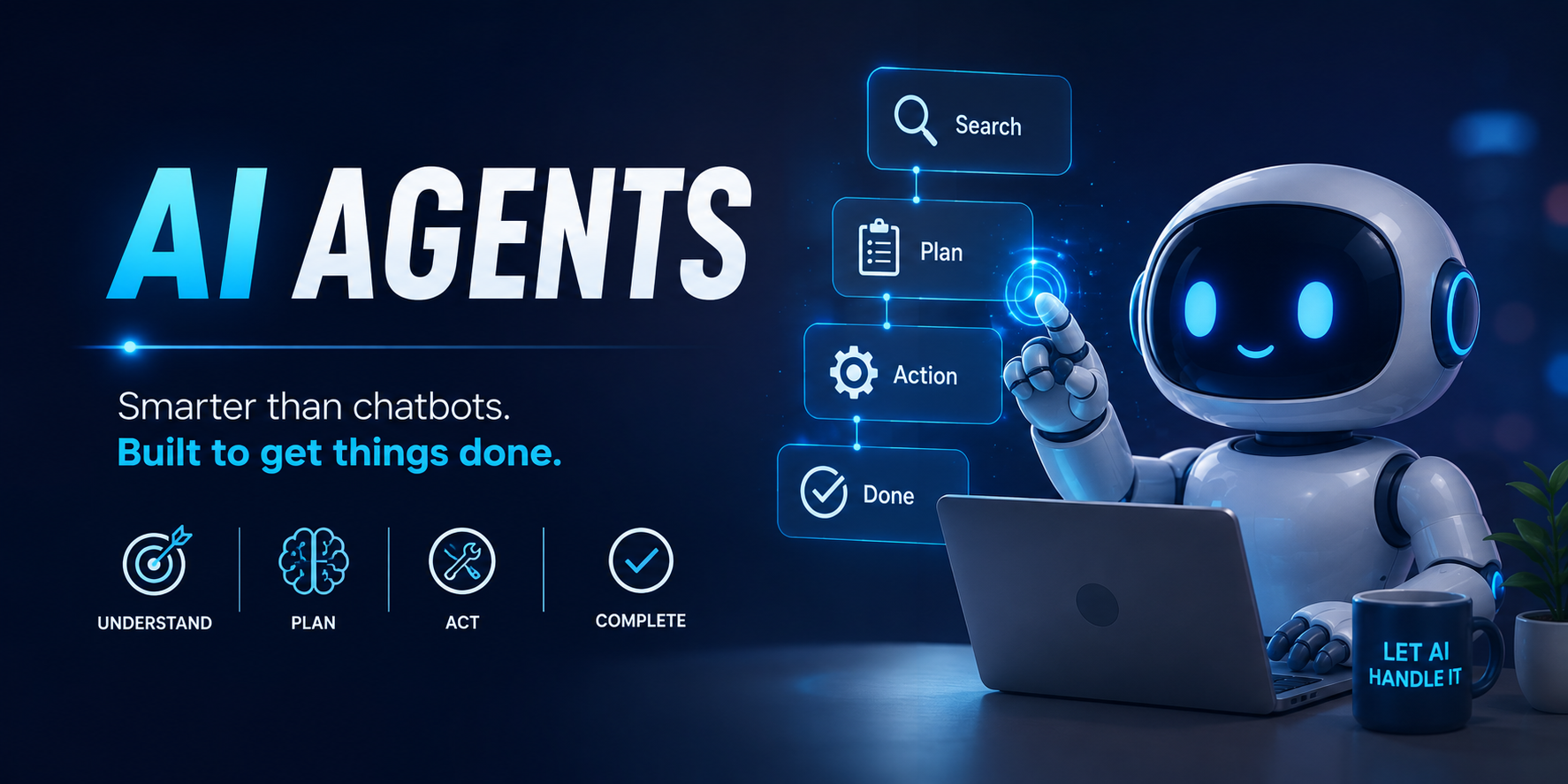
Goal → Plan → Use tools → Observe results → Adjust → Complete task
This ability to reason, act, observe outcomes, and continue working is one of the defining ideas behind agentic AI.
AI agents can also use multimodal information, including text, images, audio, video, and code, depending on the underlying AI model and tools available to them.
What Are the Main Components of an AI Agent?
1. AI model
The underlying large language model or other AI model provides the reasoning and language capabilities.
2. Tools
Tools allow an AI agent to interact with external systems. Examples include:
- Web search
- APIs
- Databases
- Web browsers
- Code execution
- File systems
- Calendars
- Business software
3. Memory
Memory allows an agent to maintain relevant information during a task and, depending on the system, across different interactions.
4. Grounding
Grounding connects an AI system to external information so it can work with current, specific, or organization-owned data.
5. Orchestration
Orchestration controls how the agent plans tasks, chooses tools, manages information, and moves from one step to another.
6. Permissions and guardrails
These controls determine what an AI agent is allowed to access and which actions require human approval.
AI Agents vs Chatbots: What’s the Difference?
The biggest difference between an AI agent and a chatbot is the ability to act toward a goal.
|
Feature |
AI Chatbot |
AI Agent |
|
Answers questions |
Yes |
Yes |
|
Generates content |
Yes |
Yes |
|
Understands natural language |
Yes |
Yes |
|
Plans multiple steps |
Limited |
Yes |
|
Uses external tools |
Sometimes |
Usually |
|
Performs actions |
Limited |
Yes |
|
Works toward a goal |
Limited |
Core capability |
|
Operates with autonomy |
Low |
Higher |
|
Adapts during a task |
Limited |
Yes |
A chatbot generally responds to a prompt.
An AI agent can take a broader objective and determine what needs to happen next.
However, the line between an AI assistant, chatbot, automation system, and AI agent is not always precise. Different companies use these terms differently.
Google Cloud distinguishes AI agents by their greater autonomy and ability to perform complex, multi-step tasks, while AI assistants generally work more directly under user supervision.
What Is Agentic AI?
Agentic AI is an approach to artificial intelligence in which AI systems can pursue goals through planning, reasoning, tool use, and action. It goes beyond generating content by enabling AI to perform or coordinate multiple steps toward an objective.
The terms AI agents and agentic AI are closely related but are not identical.
Think of an AI agent as an individual worker and agentic AI as a broader system that can coordinate multiple agents and workflows.
For example:
Generative AI: Creates a marketing campaign.
AI assistant: Helps you create and edit the campaign.
AI agent: Creates the campaign, uses connected tools to publish it, monitors results, and takes approved actions based on performance.
Google Cloud similarly describes agentic AI as the coordinated use of AI agents to handle broader and more complex workflows.
What Are Examples of AI Agents?
AI agents can be used for many tasks involving information, decision-making, and digital actions.
AI Research Agents
A research agent can search information, compare sources, organize findings, identify gaps, and create a structured report.
For example:
Goal: Research the electric vehicle market in India.
An AI research agent could gather information from multiple sources, organize the evidence, compare trends, and prepare a report for human review.
AI Coding Agents
AI coding agents can inspect software projects, identify problems, write or modify code, run tests, analyze errors, and make further changes.
This changes software development from asking AI to generate a single function toward delegating an entire coding task.
Stanford’s 2026 AI Index reports that AI-agent performance on OSWorld, a benchmark involving real computer tasks, has improved substantially, although agents still fail a significant share of attempts.
AI Customer Service Agents
An AI customer service agent could:
- Understand a customer’s problem
- Search a knowledge base
- Retrieve relevant information
- Diagnose an issue
- Update a support ticket
- Escalate complex cases
- Follow up with the customer
This could allow human employees to concentrate on cases requiring judgment or empathy.
AI Personal Assistants
An AI personal assistant could potentially help with:
- Calendar management
- Travel research
- Meeting preparation
- Documents
- Research
- Scheduling
- Routine administrative work
The key difference is that an agent can potentially perform parts of the workflow, rather than simply tell the user what to do.
AI Browser Agents
Browser-based AI agents could be particularly important to the future of the internet.
Instead of asking:
“How do I complete this online form?”
a user could eventually ask:
“Complete this form using my information and show me everything before submitting it.”
The agent could navigate the website, retrieve authorized information, fill in fields, and wait for user approval before taking the final action.
How Will AI Agents Change the Internet?
The biggest potential change is a shift from navigating websites manually to giving AI agents goals.
Today, completing many online tasks requires users to:
- Search Google or another search engine.
- Open several websites.
- Compare information.
- Choose an option.
- Fill out forms.
- Log into services.
- Complete the transaction.
With AI agents, the process could increasingly look like:
Tell the AI what you want → review the plan or results → approve important actions → let the agent complete the workflow.
This could affect:
- Google Search
- AI search
- E-commerce
- Online shopping
- Travel
- Customer service
- Software development
- Online research
- Digital marketing
- Business automation
- Financial and administrative workflows
Google’s 2026 Search updates show that this transition is already underway, with Search agents designed to monitor information and agentic capabilities for booking and shopping.
Will AI Agents Replace Search Engines?
AI agents are unlikely to simply replace search engines overnight. Instead, search is increasingly becoming one component of an AI-powered workflow. An agent can search the web, compare information, summarize results, and potentially take the next authorized action.
This could change what users expect from search.
Instead of:
Search → click → read → compare → act
the experience may increasingly become:
Ask → research → compare → decide → act
Search therefore remains important, but the role of search could expand from retrieving information to supporting AI-powered task completion.
This also creates a new challenge for website owners.
Websites may need to provide information that is not only easy for humans to understand, but also easy for AI systems to retrieve, interpret, verify, and use appropriately.
What Are the Benefits of AI Agents?
AI agents could provide several important benefits.
1. More Automation
AI agents can automate multi-step digital workflows that previously required people to move information between different applications.
2. Higher Productivity
Instead of spending time on repetitive administrative tasks, employees can delegate parts of their work to AI systems.
Google Cloud’s 2026 AI Agent Trends report highlights productivity and complex workflow automation as major areas of expected business impact.
3. Personalized Experiences
AI agents can potentially use user preferences, context, and goals to create more personalized digital experiences.
4. Easier Software Interaction
Complex software may become easier to use when people can describe what they want in natural language instead of learning every interface.
5. Multi-Agent Collaboration
Multiple specialized AI agents can work together.
For example:
- A research agent gathers information.
- An analysis agent evaluates it.
- A writing agent prepares the report.
- A review agent checks the result.
This approach could make complex AI automation more flexible and scalable.
What Are the Risks of AI Agents?
AI agents can be powerful, but greater autonomy also creates greater risks.
An incorrect chatbot response is one problem.
An AI agent that can send emails, modify records, execute code, make purchases, or access sensitive information can turn an error into a much bigger problem.
AI Hallucinations
AI agents can misunderstand information or make incorrect decisions.
Because an agent may perform several actions based on an earlier decision, one mistake can affect the rest of the workflow.
Prompt Injection
Prompt injection occurs when malicious or misleading instructions are introduced into content an AI system processes.
For example, a webpage or document could contain instructions designed to manipulate an AI agent into taking an unauthorized action.
This is particularly important for browser agents and systems that can access external content.
Excessive Permissions
An AI agent should not automatically receive access to everything a user can access.
The more permissions an agent has, the greater the potential impact of a mistake or security breach.
Privacy Risks
AI agents may have access to:
- Emails
- Documents
- Calendars
- Browsing sessions
- Company information
- Customer data
- Financial information
Strong access controls and data-minimization practices are therefore essential.
Unintended Actions
An AI agent can misunderstand what a user actually wants.
For high-impact activities—such as financial transactions, account changes, publishing information, deleting files, or sending sensitive messages—human approval can provide an important safety layer.
Are AI Agents Safe?
AI agents can be designed with strong safety controls, but they are not automatically safe. Their risk depends on the AI model, tools, permissions, data, environment, and level of autonomy. Sensitive or high-impact actions should use appropriate authentication, monitoring, access controls, validation, and human approval.
This is particularly important because AI agents are improving quickly but remain imperfect.
Stanford’s 2026 AI Index reports that AI-agent success on OSWorld rose to about 66.3%, while agents still failed roughly one in three benchmark attempts.
That means today’s AI agents can perform impressive tasks, but reliability is not yet equivalent to human-level performance across all digital workflows.
A useful security principle is:
Give an AI agent only the permissions it needs—and require approval for high-impact actions.
What Is the Future of AI Agents?
The future of AI agents is likely to involve systems that can complete increasingly complex digital tasks.
However, the most realistic future is not necessarily one where AI operates without humans.
Instead, we may see a human-AI collaboration model:
- Humans define goals.
- AI agents handle repetitive execution.
- Specialized agents handle specific tasks.
- Humans review important decisions.
- Security systems monitor agent activity.
- Agents use restricted permissions.
- Multiple agents coordinate complex workflows.
Interoperability is also becoming increasingly important.
In August 2026, Google’s Agent2Agent (A2A) protocol moved toward the Agentic AI Foundation, with a focus on enabling independent AI agents to communicate across systems. A2A complements the Model Context Protocol (MCP), which connects AI applications with tools and data.
If standards such as these mature, the internet could become increasingly interconnected with AI agents that communicate with websites, applications, APIs, and other agents.
What Do AI Agents Mean for Websites and Businesses?
AI agents are not only changing how consumers use the internet. They may also change how businesses build digital products.
Businesses should consider whether their websites and applications are easy for both humans and authorized AI systems to understand and use.
Important areas include:
- Clear and structured website content
- Accurate product and service information
- Reliable APIs
- Strong authentication
- Appropriate authorization
- Machine-readable data
- Accessible interfaces
- Clear transaction boundaries
- Monitoring and logging
- Human approval for sensitive actions
- Protection against prompt injection
- Protection against unauthorized data access
For publishers, this makes high-quality, original, trustworthy content increasingly important.
AI systems can summarize information, but reliable primary sources, transparent authorship, accurate facts, and useful original information remain important for establishing trust.
Internal linking opportunities: Add relevant links to supporting articles such as What Is Generative AI?, How AI Search Works, What Are Large Language Models?, AI SEO Guide, and How to Optimize Content for AI Search.
AI Agents vs AI Assistants vs Automation
These terms are often used interchangeably, but they describe different approaches.
Automation
Traditional automation usually follows predefined rules.
Example:
“When a customer submits a form, automatically send an email.”
AI Assistant
An AI assistant helps a user complete a task and generally operates under direct human guidance.
Example:
“Summarize these customer emails and suggest responses.”
AI Agent
An AI agent has greater autonomy and can decide which steps and tools to use while pursuing a defined goal.
Example:
“Review these customer issues, resolve routine cases using our approved procedures, and escalate exceptions.”
The boundaries are becoming less rigid as modern systems combine AI reasoning with conventional automation.
The most useful question is not simply whether a product is called an “AI agent.”
Instead, ask:
What can the AI do, what information can it access, and how much autonomy does it have?
Frequently Asked Questions About AI Agents
What is an AI agent in simple terms?
An AI agent is an AI-powered software system that can understand a goal, determine the steps needed to achieve it, use tools, and take actions. Unlike a basic chatbot, an AI agent can work through multi-step tasks and respond to the results of its actions.
How do AI agents work?
AI agents generally combine an AI model with instructions, tools, memory, external information, and an orchestration system. The agent interprets a goal, creates or follows a plan, uses available tools, evaluates the results, and continues until the task is completed or requires human intervention.
What are examples of AI agents?
Examples include AI research agents, coding agents, customer service agents, personal productivity agents, data agents, browser agents, and employee agents. Google Cloud identifies categories including employee, creative, data, and code agents.
What is the difference between an AI agent and a chatbot?
A chatbot primarily responds to user prompts. An AI agent can pursue a goal through multiple steps, use external tools, evaluate results, and take authorized actions. The distinction is mainly about autonomy, tool use, planning, and the ability to act.
What is agentic AI?
Agentic AI refers to AI systems designed to pursue goals through reasoning, planning, tool use, and action. It can involve one AI agent or multiple agents coordinating to complete complex workflows.
Can AI agents use the internet?
Yes. AI agents can be connected to search engines, websites, APIs, databases, browsers, and other online tools. However, internet access creates security risks such as prompt injection, malicious content, unauthorized actions, and potential data exposure.
Will AI agents replace human workers?
AI agents are more likely to automate parts of many jobs than immediately replace all human workers. They are particularly useful for repetitive, digital, multi-step tasks, while humans remain important for judgment, accountability, creativity, relationships, and high-impact decisions.
Why are AI agents important?
AI agents could change how people interact with technology. Instead of manually navigating several websites and applications, users may increasingly describe an outcome and delegate parts of the workflow to an AI system.
Are AI agents the future of the internet?
AI agents could become an important layer of the internet, particularly in search, shopping, travel, software, customer service, research, and business automation. Their long-term impact will depend on reliability, security, privacy, interoperability, user trust, and effective human oversight.
The Bottom Line: Why AI Agents Matter
AI agents represent a shift from AI that simply generates answers to AI that can help complete real-world digital tasks.
By combining generative AI models with tools, memory, external data, orchestration, and permissions, AI agents can potentially automate workflows that once required users to navigate multiple websites and applications manually.
That could transform:
- AI search
- Online shopping
- Business automation
- Customer service
- Software development
- Digital research
- Personal productivity
- Website interaction
But the technology has important limitations.
AI agents can still make mistakes, misunderstand instructions, encounter malicious content, expose sensitive information, or take unintended actions. As autonomy increases, security and human oversight become increasingly important.
The future of AI agents will therefore depend on more than powerful AI models.
It will depend on reliability, security, privacy, interoperability, transparency, and human control.
If those challenges are addressed effectively, the internet could evolve from a system that people navigate one website at a time into an environment where users describe what they want and trusted AI agents handle much of the work required to achieve it.
Authoritative Sources
- Google Cloud — AI agents and agentic AI concepts
- Google Search — 2026 AI Search and Search agent developments
- Stanford HAI — 2026 AI Index Report and AI-agent benchmarks
- OECD — The Agentic AI Landscape and Its Conceptual Foundations