





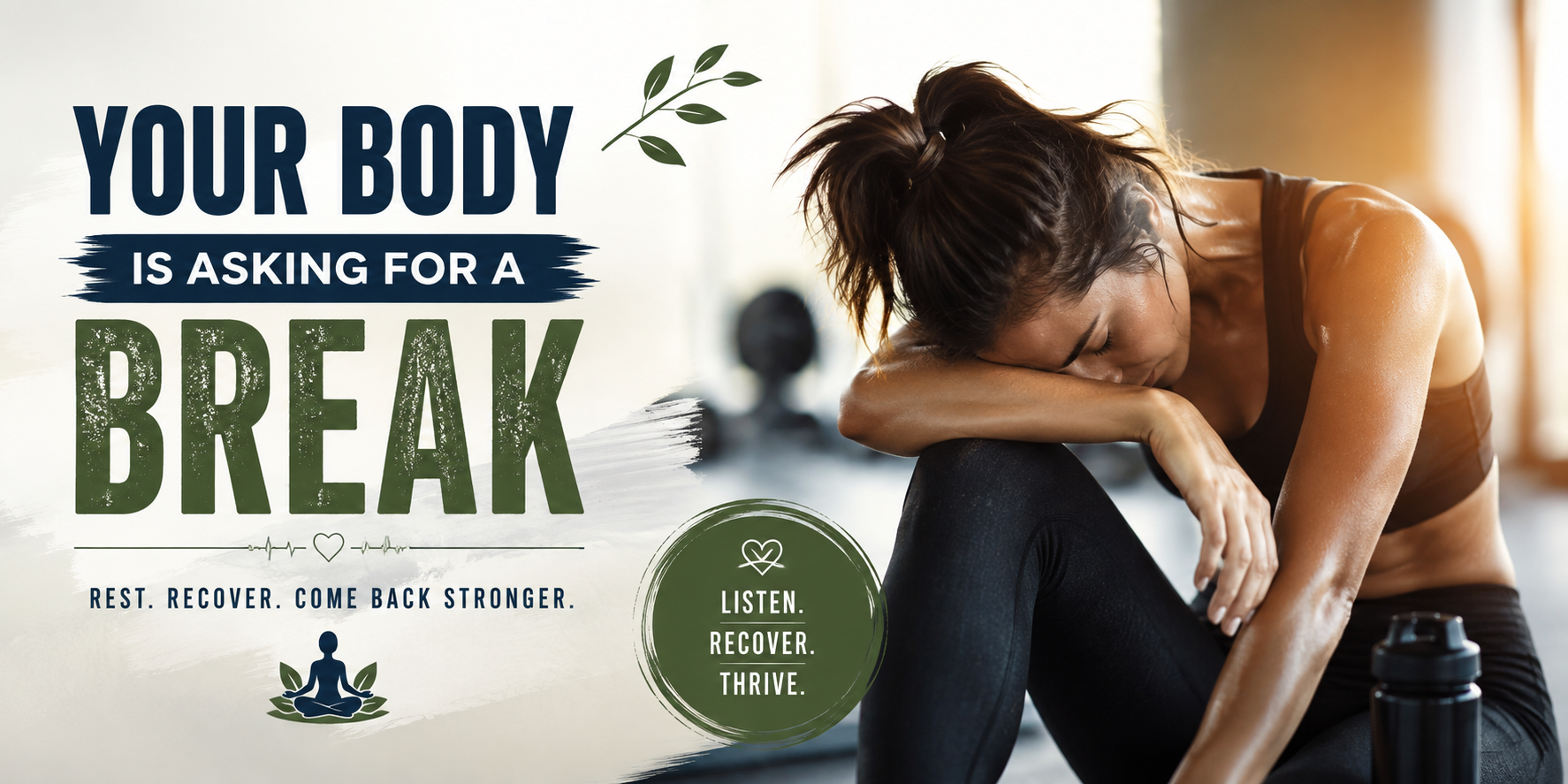
Your Body Is Asking for a Break: Signs You Need Recovery
Working out consistently can improve strength, fitness, endurance, and overall health. But exercise recovery is just as important as the workout itself.
If you are constantly tired, unusually sore, sleeping poorly, losing motivation, or finding that your normal workout suddenly feels much harder, your body may need more recovery.
The key takeaway: When your performance and well-being consistently decline instead of improving, training harder is not always the answer. Your body may need rest, better recovery, or a lower training load.
What Is Exercise Recovery?
Exercise recovery is the process of allowing your body to recover and adapt after physical stress. It includes adequate sleep, nutrition, hydration, rest, appropriate training intensity, and enough time between demanding workouts.
Recovery is not wasted time. It is part of a successful workout routine.
Training places stress on your body. Your body then needs sufficient recovery to adapt to that stress. Research on sports recovery consistently emphasizes the importance of balancing training load with recovery to support performance and reduce problems associated with under-recovery.
What Are the Signs Your Body Needs a Break?
The signs that you need a rest day can vary from person to person. One symptom does not necessarily mean you are overtraining. However, several symptoms appearing together or continuing over time are worth paying attention to.
1. Your Normal Workout Feels Much Harder
One of the most noticeable signs you need recovery is a sudden drop in workout performance.
You may notice that:
- Your usual weights feel heavier.
- Your normal running pace feels difficult.
- You get tired faster than usual.
- You need longer rest periods between sets.
- Your endurance has decreased.
- You struggle to maintain proper exercise technique.
A difficult workout after a particularly hard training session is normal. The concern is when your performance repeatedly stays below your normal level.
A temporary performance decline can occur during demanding training and may improve with recovery. Persistent performance decline, however, can indicate that the balance between training stress and recovery needs attention.
2. Your Muscle Soreness Won’t Go Away
Muscle soreness after exercise is common, especially after a new or unusually intense workout.
However, persistent soreness is different from normal post-workout discomfort.
Pay attention if:
- Muscle soreness continues without improving.
- The same area repeatedly becomes painful.
- Pain changes the way you move.
- You compensate by using other muscles.
- You continue experiencing pain between workouts.
Remember: being sore does not automatically mean your workout was effective.
If you have sharp, severe, or worsening pain, don’t assume it is simply muscle soreness.
3. You’re Tired Even After Sleeping
Persistent fatigue is another important sign that your body may need more recovery.
You might wake up feeling exhausted, struggle to concentrate during the day, or find that you don’t have your usual energy for exercise.
Sleep plays an important role in recovery. Adults generally need around 7 or more hours of sleep, although individual needs vary.
However, exercise is not the only possible cause of fatigue. Poor sleep, work stress, illness, travel, inadequate nutrition, and other health issues can also leave you feeling exhausted.
4. You’ve Lost Your Motivation to Work Out
Not wanting to exercise occasionally is completely normal.
But a persistent loss of motivation can be a sign that your body or mind needs a change in training.
You may notice that:
- Workouts you normally enjoy feel like a chore.
- You feel mentally exhausted before exercising.
- You have little enthusiasm for training.
- You feel unusually irritable or stressed about exercise.
Fatigue, performance decline, and mood changes can occur when training and recovery are poorly balanced, although these symptoms can also have many other causes.
Instead of forcing another intense workout, consider taking a rest day or switching to a lower-intensity activity.
5. Your Sleep Quality Has Changed
Poor sleep can be both a symptom and a contributor to poor exercise recovery.
Watch for:
- Trouble falling asleep
- Frequent nighttime waking
- Waking up feeling unrefreshed
- Excessive daytime sleepiness
- Changes in your usual sleep pattern
If your sleep has suddenly deteriorated while your training load has increased, it may be time to reassess your overall workload and recovery.
Persistent sleep problems should not automatically be blamed on exercise, though. Stress, medications, illness, sleep disorders, and other factors can affect sleep.
6. Your Mood Is Different
Recovery involves more than your muscles.
Changes in mood—including irritability, low motivation, anxiety, difficulty concentrating, or feeling emotionally drained—can occur alongside periods of excessive training stress.
Your overall recovery load also includes non-exercise stress such as work, relationships, travel, and inadequate sleep. Sports-science research emphasizes that recovery needs to be considered in the context of both training and other life demands.
If significant mood changes persist or interfere with everyday life, speak with a healthcare professional rather than assuming exercise is the cause.
7. You Keep Getting Sick
If you frequently feel run down or experience repeated minor illnesses while increasing your training, take a closer look at your recovery habits.
Poor load management has been associated with increased risk of illness and other negative health outcomes in athletes.
However, repeated illness can have many causes. Don’t automatically assume that exercise is responsible.
8. Your Resting Heart Rate Is Consistently Different
Some athletes use resting heart rate as one way to monitor recovery.
A persistent change from your normal baseline may be worth tracking, especially when it occurs alongside fatigue, poor sleep, reduced performance, or feeling unwell.
But resting heart rate alone cannot diagnose overtraining.
Heart rate can change because of illness, dehydration, stress, caffeine, medications, heat, sleep disruption, and other factors.
9. You’re Exercising Through Pain
Pain should not be treated as a test of determination.
Continuing to exercise through significant or worsening pain can potentially aggravate an existing problem.
Consider reducing or stopping the activity if pain:
- Changes your movement
- Reduces your strength
- Affects your balance
- Changes your exercise technique
- Continues to return
- Gets progressively worse
For persistent or significant pain, professional evaluation is more appropriate than simply adding more recovery time.
10. You Feel Guilty About Taking a Rest Day
Your relationship with exercise matters too.
If you feel guilty whenever you rest, fear losing progress after one missed workout, or feel compelled to exercise despite illness, injury, or exhaustion, consider stepping back.
A rest day is not a failed workout.
Recovery is a normal part of a healthy exercise routine, and taking time to recover does not mean you have lost your discipline.
How Do You Know If You’re Not Recovering From Exercise?
Look for patterns rather than isolated symptoms.
You may need more recovery if several of these occur together:
| Recovery warning sign | What you may notice |
|---|---|
| Poor workout performance | Normal exercises feel unusually difficult |
| Persistent fatigue | Low energy throughout the day |
| Muscle soreness | Soreness isn’t improving as expected |
| Poor sleep | Difficulty sleeping or waking unrefreshed |
| Low motivation | Less interest in training |
| Mood changes | Irritability, anxiety, or emotional fatigue |
| Frequent illness | Feeling run down or repeatedly sick |
| Slow recovery | Taking longer than usual to feel ready for training |
A simple workout recovery log can help you identify patterns. Track your training, sleep, soreness, energy, mood, and perceived effort over time.
Rest Day vs. Active Recovery: What’s the Difference?
A rest day means substantially reducing or stopping structured exercise. Active recovery involves low-intensity movement that is easier than your normal training, such as an easy walk or gentle mobility work.
A complete rest day may be better when:
- You’re unusually exhausted.
- You’re sick.
- You have significant pain.
- Your performance has repeatedly declined.
- Even light activity makes you feel worse.
Active recovery may be appropriate when:
- You generally feel well.
- You have mild post-workout stiffness.
- Gentle movement feels comfortable.
- Activity does not increase pain or fatigue.
The goal is not to stay active every day at all costs. The goal is to match your exercise intensity to your recovery level.
How Much Recovery Do You Need After a Workout?
There is no single number of recovery hours that works for everyone.
Your recovery needs depend on:
- Workout intensity
- Training volume
- Exercise type
- Fitness level
- Age
- Sleep
- Nutrition
- Hydration
- Stress
- Illness or injury
- Recent training load
A hard strength workout and an easy walk place very different demands on the body.
Instead of asking only, “How many rest days do I need?”, ask:
“Am I recovered enough to safely handle today’s workout?”
If the answer is repeatedly no, your training program may need more recovery, lower intensity, or less overall volume.
How Can You Recover Faster After a Workout?
The basics of recovery are often more important than complicated recovery products.
1. Get Enough Sleep
Sleep is one of the foundations of exercise recovery.
Aim for a consistent sleep schedule and enough sleep to feel rested. Adults generally need at least 7 hours, although individual requirements vary.
2. Eat Enough Food
Your body needs adequate energy and nutrients to support exercise and recovery.
Persistent fatigue should not automatically be addressed with more caffeine or supplements. Inadequate energy intake and insufficient nutrition can contribute to poor recovery and underperformance.
3. Stay Hydrated
Hydration needs vary depending on exercise, climate, sweat loss, body size, and other factors.
Drink enough fluids to replace losses without assuming that excessive fluid intake is better.
4. Reduce Your Workout Intensity
Recovery doesn’t necessarily mean stopping all movement.
You can temporarily reduce:
- Workout duration
- Training frequency
- Weight or resistance
- Running mileage
- Exercise intensity
- Number of high-intensity sessions
This can allow you to maintain movement while reducing training stress.
5. Alternate Hard and Easy Workouts
Doing intense workouts every day can increase your recovery demands.
Alternating harder sessions with easier training or rest days can help create a better balance between workout stress and recovery.
6. Manage Your Overall Stress
Your body has to deal with more than exercise.
Work, family responsibilities, poor sleep, travel, illness, emotional stress, and inadequate nutrition can all affect your ability to recover.
Think about total stress, not just the number of workouts you complete.
Can You Exercise Too Much?
Yes. While regular physical activity provides many health benefits, more exercise is not always better.
Effective training requires an appropriate balance between exercise stress and recovery. A temporary decline in performance can happen during demanding training and may improve after sufficient recovery. Problems become more concerning when performance remains suppressed and symptoms persist.
True overtraining syndrome is more complicated than simply feeling tired after a workout. It involves prolonged underperformance and requires consideration of other possible causes, including illness, inadequate nutrition, sleep problems, and psychological stress.
That’s why the phrase “I’m overtrained” should not automatically be used to describe every period of fatigue.
What Is the Difference Between Normal Workout Fatigue and Overtraining?
| Normal exercise fatigue | Possible under-recovery |
| Temporary tiredness | Persistent fatigue |
| Performance returns after recovery | Performance repeatedly declines |
| Soreness gradually improves | Soreness persists or worsens |
| Motivation remains generally normal | Motivation may decrease |
| Sleep is relatively normal | Sleep may become disrupted |
| Rest or lighter training helps | Symptoms continue despite reduced training |
This is a general comparison, not a diagnostic test.
Research has found that the scientific evidence for identifying overtraining syndrome from a specific collection of symptoms remains limited.
When Should You Stop Exercising and See a Doctor?
Not every symptom is caused by a lack of recovery.
Seek medical attention for severe, persistent, unexplained, or worsening symptoms, particularly:
- Chest pain or pressure
- Fainting or near-fainting
- Severe shortness of breath
- A new or sustained abnormal heartbeat
- Severe weakness
- Significant injury or swelling
- Dark urine accompanied by severe muscle pain or weakness
- Unexplained weight loss
- Persistent fever or illness
- Symptoms that significantly interfere with daily activities
If you have a medical condition, take medications that affect exercise tolerance, are pregnant, or are returning to exercise after illness or injury, discuss your exercise and recovery plan with a qualified healthcare professional.
What Should You Do If Your Body Needs a Break?
If several recovery warning signs are appearing, don’t automatically push harder.
Follow these recovery steps:
- Reduce or stop the activity that is causing symptoms.
- Prioritize adequate, consistent sleep.
- Eat enough to support your activity level.
- Hydrate appropriately.
- Choose gentle movement only if it feels comfortable.
- Track your sleep, energy, soreness, mood, and workout performance.
- Gradually return to harder workouts when you feel recovered.
- Seek professional advice if symptoms persist or concern you.
For athletes with suspected overtraining, clinicians may recommend relative or complete rest while identifying factors contributing to the problem.
Frequently Asked Questions About Exercise Recovery
How do I know when my body needs a rest day?
Your body may need a rest day when you experience unusual fatigue, persistent muscle soreness, declining workout performance, poor sleep, illness, or significant loss of motivation. One symptom does not necessarily mean you need complete rest, but a pattern of several symptoms is a good reason to reassess your training.
Is it okay to work out when you’re sore?
Mild, familiar post-workout soreness does not always require complete rest. However, avoid exercising through sharp, severe, worsening, or movement-altering pain. If soreness continues or repeatedly interferes with your workouts, reduce your training load and consider professional guidance.
Can lack of sleep affect muscle recovery?
Yes. Sleep is an important part of physical recovery and overall health. Adults generally need at least 7 hours of sleep, although individual needs vary. Poor sleep can also affect energy, mood, concentration, and exercise performance.
How many rest days should I take each week?
There is no universal number of rest days that works for everyone. Your ideal recovery schedule depends on workout intensity, training volume, fitness level, sleep, nutrition, stress, age, and health. Some people need more frequent rest or low-intensity days than others.
Will I lose muscle or fitness if I take a rest day?
A normal rest day does not erase your training progress. Recovery gives your body time to respond to training stress. A sustainable exercise program balances challenging workouts with enough recovery to continue progressing.
What is the fastest way to recover after a hard workout?
Start with the fundamentals: get enough sleep, eat adequately, hydrate appropriately, and allow enough time before another demanding workout. If fatigue or performance problems persist, reducing training load is generally more sensible than simply adding more supplements or recovery products.
Is it normal to feel tired after exercise?
Yes. Temporary fatigue after a challenging workout is normal. Persistent or unusually severe fatigue is more concerning, especially when accompanied by declining performance, poor sleep, prolonged soreness, mood changes, repeated illness, or difficulty completing workouts that were previously manageable.
What is overtraining syndrome?
Overtraining syndrome is a complex condition associated with prolonged performance decline and inadequate recovery from accumulated stress. It is not diagnosed simply because you feel tired after exercising. Other potential causes of fatigue and poor performance must also be considered.
The Bottom Line: Rest and Recovery Are Part of Fitness
Your body does not need you to ignore every warning sign to prove that you’re committed to fitness.
Persistent fatigue, declining workout performance, prolonged muscle soreness, poor sleep, mood changes, and low motivation can all be signals to reassess your training and recovery.
These symptoms do not automatically mean you have overtraining syndrome. But they can indicate that your current workout routine is placing more stress on your body than you can comfortably recover from.
The best recovery strategy is usually simple: sleep enough, eat adequately, stay hydrated, manage your overall stress, vary workout intensity, and give your body time to adapt.
If something feels significantly wrong or does not improve after reducing your training, don’t assume you simply need more motivation.
Sometimes the smartest fitness decision is to take a break, recover, and find out what your body is telling you.