





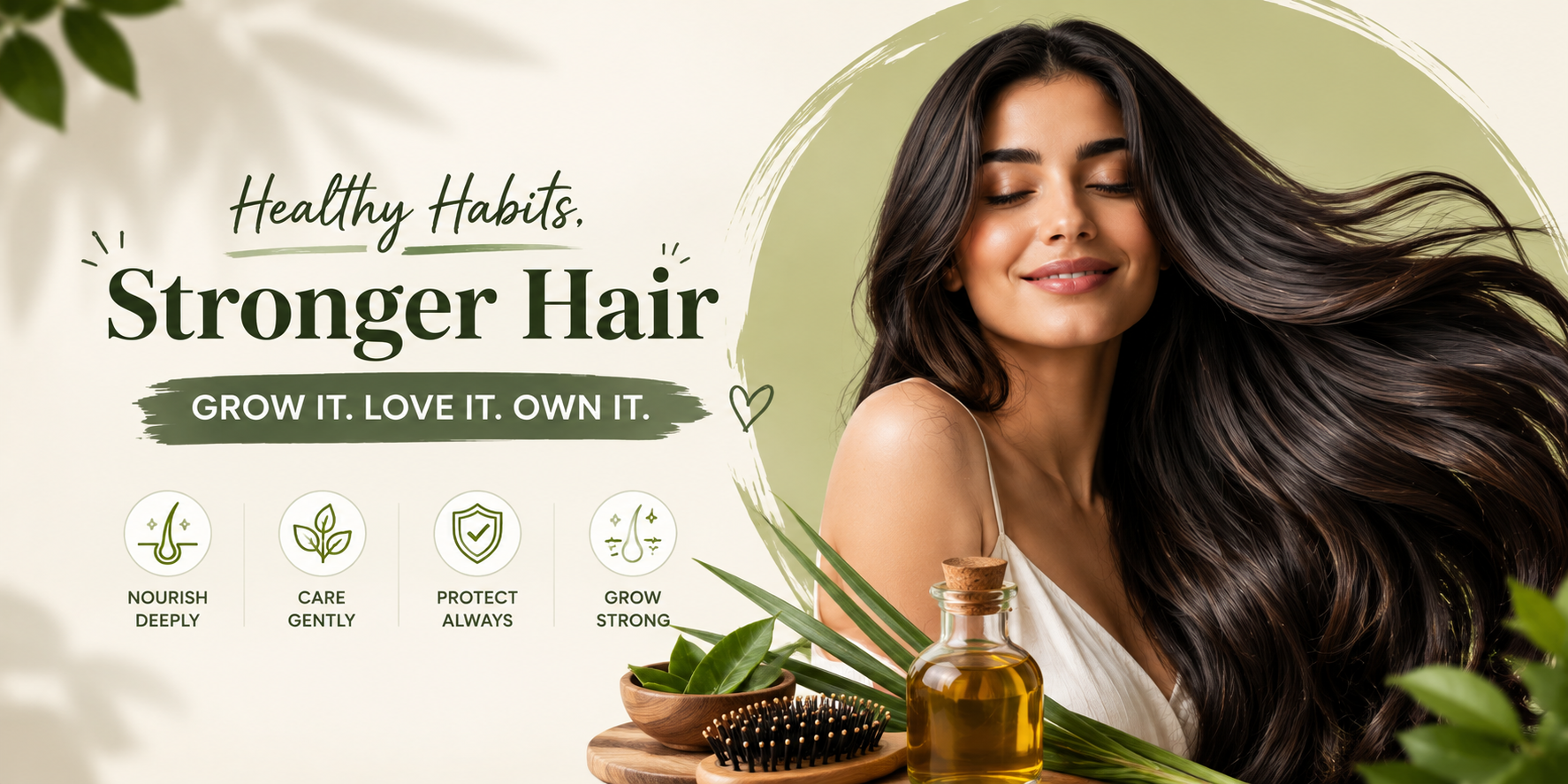
If you’re searching for how to grow hair faster, the most important thing to know is that there is no overnight solution. Scalp hair grows from follicles at a natural rate that varies between people. Cleveland Clinic reports that scalp hair grows about 1 centimeter per month on average, or roughly 4–6 inches per year.
However, you can improve your chances of growing longer, healthier hair by supporting your scalp, eating a balanced diet, reducing breakage, and avoiding hair-care habits that damage the strands.
The goal isn’t simply to make hair grow faster. It’s to grow healthy hair and retain more of the length you naturally produce.
Here are 10 hair growth tips that actually matter.
1. Keep Your Scalp Clean and Healthy
A healthy scalp is an important foundation for a good hair growth routine.
Wash your hair based on how quickly your scalp becomes oily or dirty. The American Academy of Dermatology recommends applying shampoo primarily to the scalp, where oil, dead skin cells, and product buildup accumulate, rather than aggressively washing the entire length of your hair.
For better scalp care:
- Choose shampoo according to your scalp and hair type.
- Don’t aggressively scratch your scalp.
- Cleanse regularly enough to control oil and buildup.
- Address persistent dandruff, itching, redness, or irritation.
- Avoid products that consistently cause scalp irritation.
A clean, healthy scalp does not magically make hair grow overnight, but good scalp care helps maintain healthy hair and reduces avoidable damage.
2. Eat a Balanced Diet for Healthy Hair Growth
What you eat can affect your hair.
Your body needs adequate energy, protein, iron, and other nutrients to support normal hair growth. Restrictive dieting and inadequate intake of certain nutrients can contribute to hair shedding or hair loss.
Add more nutrient-dense foods such as:
- Eggs
- Fish
- Lentils
- Beans
- Soy foods
- Dairy or fortified alternatives
- Nuts and seeds
- Leafy green vegetables
- Whole grains
- Fruits and vegetables
Does protein help hair growth?
Yes, adequate protein is important because hair is primarily made of a protein called keratin. However, eating excessive amounts of protein will not automatically make your hair grow faster.
The better goal is a balanced diet with enough protein and essential nutrients.
3. Reduce Heat Styling to Prevent Hair Breakage
Frequent heat styling can weaken the hair shaft and contribute to dryness and breakage.
Flat irons, curling irons, hot combs, and high-heat blow dryers can damage hair when used excessively. Dermatologists recommend limiting heat exposure and using low or medium settings when heat styling is necessary.
Better heat-styling habits:
- Use low or medium heat.
- Let hair partially air-dry when possible.
- Avoid repeatedly heating the same section.
- Use a suitable heat-protectant product.
- Reduce how frequently you use flat irons and curling tools.
Why does this matter for hair growth?
Because excessive breakage can make it appear as though your hair isn’t growing, even when new hair is growing normally from the scalp.
4. Use Conditioner to Reduce Breakage
If your goal is longer hair, length retention matters.
Conditioner helps moisturize and detangle the hair, making it easier to manage and potentially reducing mechanical damage. The AAD recommends using conditioner after shampooing and adjusting where you apply it according to your hair type.
Simple hair-care routine:
Shampoo → Conditioner → Gentle detangling → Air-dry or low heat
For fine or straight hair, conditioner can be concentrated toward the ends. Dry or curly hair may benefit from conditioning more of the length.
A leave-in conditioner or detangler can also help make hair easier to manage and reduce unnecessary pulling.
5. Avoid Tight Hairstyles That Pull on Your Roots
Tight hairstyles can cause more than temporary discomfort.
Repeated tension from tight ponytails, buns, braids, cornrows, extensions, or similar styles can contribute to traction alopecia, a form of hair loss caused by pulling on the hair. Continued tension can potentially cause permanent hair loss.
Protect your hair by:
- Wearing looser ponytails.
- Avoiding consistently tight buns.
- Changing hairstyles regularly.
- Taking breaks from extensions.
- Avoiding styles that cause scalp pain.
- Paying attention to thinning around the hairline.
Rule of thumb: If your hairstyle hurts or feels excessively tight, loosen it.
6. Be Gentle With Wet Hair
Wet hair is more vulnerable to mechanical damage.
Instead of aggressively rubbing your hair with a towel, gently squeeze out excess water. When detangling, work from the ends upward and avoid pulling through knots.
The AAD recommends gentle handling, appropriate combing techniques, and reducing friction while drying.
Try this:
- Gently remove excess water.
- Use a soft towel or T-shirt to absorb moisture.
- Apply conditioner or detangler if needed.
- Start detangling at the ends.
- Slowly work toward the roots.
- Avoid forcefully pulling through tangles.
This simple habit can help reduce hair breakage and improve length retention.
7. Limit Excessive Coloring and Chemical Treatments
Bleaching, frequent coloring, chemical straightening, relaxing, and perming can weaken hair.
You don’t necessarily need to eliminate every chemical treatment, but reducing frequency and avoiding overlapping damaging treatments can help preserve hair strength.
If your hair is already:
- Very dry
- Brittle
- Breaking easily
- Extremely frizzy
- Thinning
consider reducing chemical processing and focusing on gentle hair care.
Healthy hair growth isn’t only about the scalp. Your existing hair needs to remain strong enough to retain length.
8. Stop Over-Brushing Your Hair
Does brushing your hair 100 times a day make it grow faster?
No.
More brushing does not make hair follicles produce hair faster. Excessive brushing or aggressive combing can increase mechanical stress and breakage.
The AAD recommends brushing or combing gently and only as much as needed for styling.
Better approach:
Detangle gently → style → leave your hair alone.
Avoid repeatedly pulling, twisting, or manipulating your hair throughout the day.
Less unnecessary manipulation can mean less breakage.
9. Don’t Rely on Hair Growth Supplements Without a Reason
Hair growth vitamins and biotin supplements are heavily marketed, but supplements are not a guaranteed solution for everyone.
If you have a nutritional deficiency, correcting it may be important. But taking large amounts of vitamins or minerals without knowing whether you need them can be counterproductive. The AAD specifically warns that excessive amounts of certain nutrients can actually worsen hair loss.
Before taking hair supplements:
- Look at your overall diet.
- Discuss unexplained hair loss with a healthcare professional.
- Consider testing for suspected nutritional deficiencies when medically appropriate.
- Avoid taking multiple high-dose supplements unnecessarily.
Important: More vitamins do not automatically equal faster hair growth.
10. Find the Cause of Excessive Hair Loss
Sometimes the problem isn’t that your hair is growing too slowly.
You may actually be experiencing hair shedding or hair loss.
Hair loss can have many causes, including genetics, hormonal changes, nutritional deficiencies, illness, medications, stress, and scalp conditions.
See a dermatologist if you notice:
- Sudden hair loss
- Bald patches
- Significant thinning
- A widening part
- Receding hairline
- Persistent excessive shedding
- Scalp pain or inflammation
- Persistent itching or scaling
- Hair loss that continues to worsen
A dermatologist can help determine whether you’re dealing with breakage, excessive shedding, hereditary hair loss, or another condition.
How Fast Does Hair Grow?
Most people cannot dramatically change their natural hair-growth rate through home remedies.
Scalp hair grows approximately 1 centimeter per month on average, although individual growth varies. Hair also moves through different growth, transition, and resting phases.
That means approximate growth could look like this:
| Time | Approximate average growth |
| 1 month | ~1 cm |
| 3 months | ~3 cm |
| 6 months | ~6 cm |
| 12 months | ~12 cm |
These numbers are averages, not guarantees.
Genetics, age, health, hormones, nutrition, and the natural hair-growth cycle can all influence individual results.
How to Make Hair Grow Faster Naturally
If you’re looking for how to grow hair naturally, focus on habits that support normal growth and reduce breakage.
The best natural hair-growth habits are:
- Eat a balanced diet
Get enough protein and essential nutrients. - Maintain scalp hygiene
Wash according to your scalp and hair type. - Reduce heat damage
Use lower temperatures and style less frequently. - Condition regularly
Improve manageability and reduce friction. - Avoid tight hairstyles
Reduce repeated tension on your roots. - Handle wet hair gently
Minimize pulling and rough towel drying. - Limit chemical damage
Avoid excessive bleaching, relaxing, or chemical processing. - Protect your hair length
Focus on preventing split ends and breakage. - Don’t blindly take supplements
Correct deficiencies rather than assuming supplements will help. - Address unexplained hair loss
Get professional advice when shedding or thinning is unusual.
Hair Growth vs. Hair Length: What’s the Difference?
This is one of the most important concepts when trying to grow long hair.
Hair growth happens at the follicle.
Hair length retention depends on how much of that newly grown hair remains without breaking.
For example, imagine your hair grows approximately 1 cm in a month. If damaged ends repeatedly break, you may retain very little visible length.
That’s why a good hair growth routine should focus on both:
Healthy growth + less breakage = better length retention
This is often more useful than constantly searching for a new “miracle” hair-growth product.
Do Hair Oils Make Hair Grow Faster?
Hair oils are popular in natural hair-care routines, but they should not be presented as guaranteed hair-growth treatments.
Some oils can help condition hair, improve softness, reduce friction, or support scalp comfort. However, applying oil to your hair does not automatically increase the natural growth rate of your follicles.
Recent hair-care coverage continues to highlight oils such as castor and rosemary oil, but evidence for dramatically accelerating hair growth remains limited.
If you use an essential oil, dilute it appropriately and stop if irritation occurs.
Does Cutting Hair Make It Grow Faster?
No. Cutting the ends does not make hair follicles grow faster.
Hair grows from the follicle underneath the scalp, not from the ends.
However, trimming damaged ends can make hair look healthier and may help manage split ends and breakage.
So think of trimming as a length-retention and appearance strategy, not a hair-growth accelerator.
What Is the Best Hair Growth Routine?
A simple routine is usually easier to maintain than a complicated one.
Morning
- Avoid unnecessary brushing.
- Choose a low-tension hairstyle.
- Protect hair from excessive environmental or heat exposure.
Wash Day
Cleanse scalp → condition hair → gently detangle → dry carefully
Weekly
- Check for excessive dryness or breakage.
- Minimize unnecessary heat styling.
- Avoid repeatedly wearing tight hairstyles.
- Evaluate whether your current products suit your hair type.
Long-term
- Eat a balanced diet.
- Maintain consistent scalp care.
- Reduce chemical and heat damage.
- Monitor changes in shedding or hair density.
Consistency matters more than constantly changing products.
7 Hair Growth Mistakes That Can Slow Your Progress
If your hair seems stuck at the same length, check these common mistakes:
1. Using too much heat
Excessive heat can damage the hair shaft.
2. Wearing tight hairstyles every day
Repeated tension can contribute to traction alopecia.
3. Brushing aggressively
Pulling through knots can cause breakage.
4. Ignoring scalp problems
Persistent irritation, scaling, or inflammation deserves attention.
5. Crash dieting
Not consuming enough calories or nutrients can contribute to hair shedding.
6. Taking unnecessary supplements
High doses of some nutrients can actually worsen hair loss.
7. Expecting overnight results
Hair growth is a gradual biological process.
10 Hair Growth Tips to Remember
If you only remember the essentials, remember these:
- Keep your scalp clean and comfortable.
- Eat enough protein and maintain a balanced diet.
- Use conditioner regularly.
- Reduce excessive heat styling.
- Avoid tight hairstyles.
- Treat wet hair gently.
- Limit excessive chemical processing.
- Reduce unnecessary brushing and manipulation.
- Don’t take high-dose supplements without a reason.
- See a dermatologist for unexplained or significant hair loss.
Frequently Asked Questions
What is the fastest way to grow hair faster?
There is no proven way to dramatically accelerate your natural hair-growth rate overnight. The most effective strategy is to support normal growth with good nutrition and scalp care while preventing breakage from heat, chemicals, tight hairstyles, and rough handling.
How can I grow my hair faster naturally?
Focus on a balanced diet, adequate protein, healthy scalp care, gentle styling, regular conditioning, and reduced heat and chemical damage. These habits support healthy hair and help you retain the length your follicles naturally produce.
How can I grow hair faster and thicker?
Healthy hair growth depends on factors such as genetics, nutrition, hormones, health, and the hair-growth cycle. If your hair is thinning, focus on identifying the cause rather than relying only on cosmetic products or supplements.
Does oil help hair growth?
Hair oil can condition the hair and reduce friction, depending on the product and your hair type. However, there is limited evidence that ordinary hair oils dramatically increase the follicle’s natural growth rate.
Does rosemary oil grow hair?
Rosemary oil is popular for hair care and has some preliminary research behind it, but it should not be marketed as a guaranteed hair-regrowth treatment. More robust research is needed before it can be considered equivalent to established medical treatments.
Does biotin make hair grow faster?
Biotin is important for normal health, and biotin deficiency can cause hair loss. However, taking extra biotin does not guarantee faster hair growth if you already get enough. Avoid high-dose supplementation unless a healthcare professional recommends it.
Why is my hair not growing longer?
Your hair may be growing from the scalp but breaking at the ends. Heat styling, chemical treatments, tight hairstyles, rough brushing, and poor hair handling can reduce length retention.
How long does it take to grow 6 inches of hair?
At an average growth rate of around 1 centimeter per month, 6 inches of hair growth would take roughly 15 months. Individual growth rates vary, so this is only an estimate.
How many times should I wash my hair for hair growth?
There is no single ideal washing schedule for everyone. Wash based on how oily or dirty your scalp becomes and your hair type. The AAD recommends adjusting washing frequency according to individual scalp and hair needs.
Can stress cause hair loss?
Yes. Significant physical or emotional stress can contribute to increased hair shedding in some people. If shedding is persistent, severe, or accompanied by noticeable thinning, professional evaluation can help identify the cause.
When should I see a dermatologist for hair loss?
See a dermatologist if you experience sudden hair loss, bald patches, significant thinning, a rapidly widening part, persistent excessive shedding, or scalp symptoms such as pain, redness, or scaling. Hair loss can have many different causes and may require targeted treatment.
The Bottom Line
The best answer to “how to grow hair faster” is not a miracle oil, expensive serum, or supplement.
Focus on what you can actually control:
Healthy scalp + balanced nutrition + gentle hair care + less damage + better length retention
Your hair grows according to its natural biological cycle, and average scalp hair growth is around 1 cm per month.
You may not be able to dramatically change that rate, but you can help your hair reach its natural potential by reducing preventable breakage and taking better care of your scalp and strands.
If you’re experiencing unexplained thinning or significant hair loss, don’t keep experimenting with home remedies indefinitely. A dermatologist can help identify the underlying cause and recommend appropriate treatment.
Trusted Sources
- American Academy of Dermatology (AAD): Healthy hair care and hair-loss guidance
- Cleveland Clinic: Hair-growth cycle and average growth rate
- Healthline: Current overview of hair-growth habits and breakage prevention