





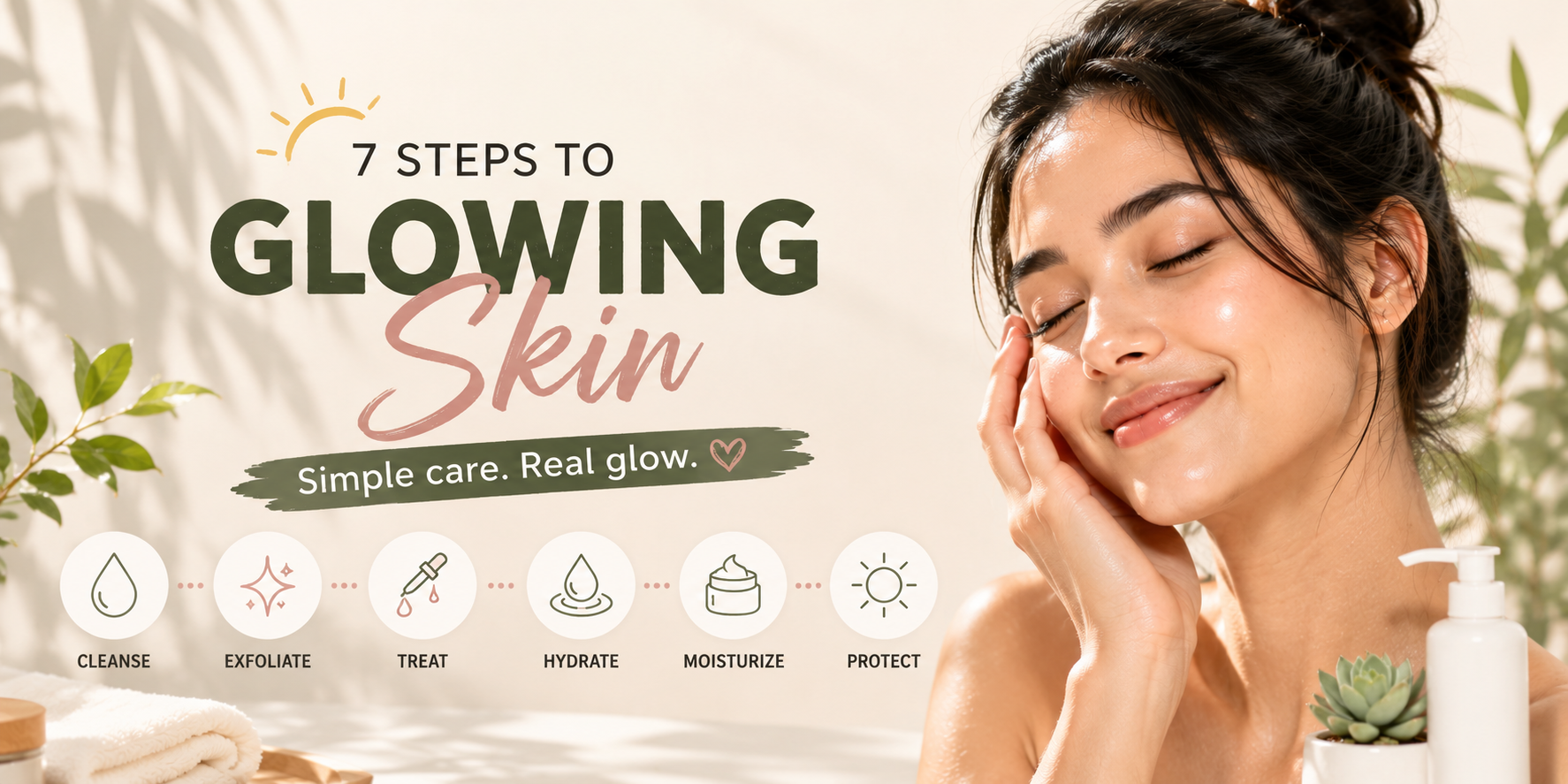
Glowing skin does not require a complicated 10-step routine. The right skincare routine for glowing skin focuses on a few essentials: gentle cleansing, exfoliation when needed, hydration, targeted skincare ingredients, moisturizer, and daily sunscreen.
The key is consistency. Instead of constantly buying trending products, build a simple routine around your skin type and specific skin concerns.
What Is the Best Skincare Routine for Glowing Skin?
The best skincare routine for glowing skin starts with gentle cleansing, followed by targeted skincare products, hydration, moisturizer, and broad-spectrum SPF 30+ sunscreen during the day. At night, cleanse your skin and use appropriate treatments before moisturizing. A simple routine used consistently is often more practical than a complicated routine with too many active ingredients.
7 Steps for a Glowing Skin Routine
1. Cleanse Your Face Gently
A gentle face cleanser is the foundation of a daily skincare routine. Cleansing helps remove excess oil, sweat, dirt, makeup, and sunscreen without unnecessarily irritating the skin.
Choose a cleanser based on your skin type rather than choosing the strongest formula available.
Simple cleansing tips:
- Use lukewarm water.
- Massage cleanser gently with your fingertips.
- Avoid harsh scrubbing.
- Rinse thoroughly.
- Pat your face dry instead of rubbing.
For dry or sensitive skin, a gentle, fragrance-free cleanser may be a better choice.
2. Exfoliate for Smoother-Looking Skin
Exfoliation can help improve the appearance of dull, rough, or uneven skin by removing excess dead skin cells.
Popular exfoliating ingredients include:
- Salicylic acid (BHA) for oily or congested skin
- Glycolic acid (AHA) for surface exfoliation
- Lactic acid for a gentler exfoliating option
However, over-exfoliation can irritate your skin. Start slowly and adjust the frequency according to your skin’s tolerance.
You do not need to exfoliate every day to achieve glowing skin.
3. Use a Targeted Serum
A face serum for glowing skin can target a specific concern more directly than a basic moisturizer.
Popular skincare ingredients include:
| Skin Concern | Common Ingredients |
| Dull skin | Vitamin C, AHAs |
| Dry skin | Hyaluronic acid, glycerin |
| Dark spots | Vitamin C, niacinamide, azelaic acid |
| Oily skin | Niacinamide, salicylic acid |
| Fine lines | Retinoids |
| Skin barrier support | Ceramides, glycerin |
Do not introduce multiple strong active ingredients at the same time. Start with one product, monitor how your skin responds, and build gradually.
4. Hydrate Your Skin
Skin hydration is essential for a healthy-looking complexion. Dehydrated skin can feel tight, rough, or uncomfortable and may appear less radiant.
Look for hydrating ingredients such as:
- Hyaluronic acid
- Glycerin
- Panthenol
- Aloe vera
- Ceramides
A hydrating serum can be especially useful if your skin feels dry or tight, but you do not necessarily need a separate hydration product if your moisturizer already provides enough hydration.
5. Apply a Face Moisturizer
A good face moisturizer helps support the skin barrier and reduce moisture loss.
Even oily skin can benefit from moisturizer. The trick is choosing the right texture.
Choose according to your skin type:
- Dry skin: Rich cream or moisturizing balm
- Oily skin: Lightweight gel or lotion
- Combination skin: Lightweight moisturizer
- Sensitive skin: Gentle, fragrance-free moisturizer
- Acne-prone skin: Non-comedogenic moisturizer
If your skin feels comfortable, soft, and balanced after moisturizing, you are likely using a suitable formula.
6. Never Skip Sunscreen
If you want to maintain healthy-looking skin, daily sunscreen should be a non-negotiable part of your morning skincare routine.
Choose a broad-spectrum sunscreen with SPF 30 or higher. Sunscreen helps protect skin from UV radiation and is an important part of preventing sunburn and premature skin aging.
For better daily sun protection:
- Apply sunscreen as the final morning skincare step.
- Cover exposed areas, including the neck.
- Apply before going outdoors.
- Reapply when spending extended time outdoors, especially after swimming or sweating.
If hyperpigmentation is a concern, tinted sunscreens containing iron oxides may provide additional protection against visible light.
7. Follow a Simple Night Skincare Routine
Your night skincare routine does not need to be complicated.
A basic nighttime routine can be:
Cleanser → Serum/Treatment → Moisturizer
Nighttime can be a convenient opportunity to use targeted ingredients such as retinoids if they are appropriate for your skin.
If you use retinol or another active ingredient, introduce it gradually. Dryness, peeling, or irritation can occur when strong treatments are introduced too quickly.
Morning vs. Night Skincare Routine
| Skincare Step | Morning | Night |
| Cleanser | ✓ | ✓ |
| Exfoliator | Optional | Optional |
| Serum | Optional | Optional |
| Hydrating product | Optional | Optional |
| Moisturizer | ✓ | ✓ |
| Sunscreen | ✓ | — |
| Retinoid/targeted treatment | — | Optional |
Your routine should be adjusted according to your skin type, skin concerns, and product tolerance.
Best Skincare Routine for Different Skin Types
Oily Skin
Oily skin can benefit from lightweight, non-comedogenic skincare products.
Simple routine:
Cleanser → Serum → Lightweight moisturizer → SPF
Dry Skin
Focus on hydration and protecting the skin barrier.
Simple routine:
Gentle cleanser → Hydrating serum → Moisturizer → SPF
Combination Skin
Use lightweight products and give extra moisture to areas that become dry.
Simple routine:
Cleanser → Targeted serum → Moisturizer → SPF
Sensitive Skin
Keep your skincare routine simple and avoid introducing several new products at once.
Simple routine:
Gentle cleanser → Moisturizer → SPF
Acne-Prone Skin
Choose non-comedogenic products and introduce acne treatments gradually. Avoid excessive scrubbing and over-exfoliation.
Simple routine:
Gentle cleanser → Acne treatment → Moisturizer → SPF
Do You Need a 10-Step Skincare Routine?
No. A 10-step skincare routine is not necessary for healthy-looking, glowing skin. A basic routine built around cleansing, moisturizing, targeted treatment when needed, and daily sunscreen can provide a strong foundation. Adding too many active ingredients can increase irritation, so focus on products that solve a specific skincare problem.
How Can I Get Glowing Skin Naturally?
The easiest way to support naturally glowing skin is to focus on consistent skincare and healthy habits. Protect your skin from UV exposure, use a suitable moisturizer, avoid excessive exfoliation, cleanse gently, and choose products based on your skin type.
Healthy-looking skin is a long-term goal rather than an overnight result.
Common Skincare Mistakes to Avoid
Over-Exfoliating
Using acids or scrubs too frequently can leave your skin irritated and dry.
Skipping Moisturizer
Oily skin still needs hydration. Choose a lightweight, non-comedogenic moisturizer instead of skipping it completely.
Forgetting Sunscreen
UV exposure can contribute to sunburn, premature skin aging, and pigmentation.
Using Too Many Active Ingredients
Combining several powerful ingredients can increase the risk of irritation. Introduce new products gradually.
Following Every Viral Skincare Trend
A product trending on social media may not be suitable for your skin type. Ingredients and formulation matter more than popularity.
Changing Your Routine Too Frequently
Give your routine time to work and avoid constantly switching products without a clear reason.
How Long Does It Take to Get Glowing Skin?
There is no fixed timeline for glowing skin. Hydration and softness may improve sooner, while acne, pigmentation, uneven skin tone, and signs of aging usually require more consistent care.
The most important factors are product suitability, correct use, consistency, and sun protection.
If you experience persistent irritation, severe acne, unusual pigmentation, or another ongoing skin concern, consider consulting a qualified dermatologist.
Can You Get Glowing Skin Without Expensive Skincare Products?
Yes. An effective skincare routine does not have to contain expensive products.
A simple routine can include:
Morning:
Cleanser → Moisturizer → SPF 30+ sunscreen
Night:
Cleanser → Targeted treatment → Moisturizer
Choose products based on your skin type and specific concerns instead of price or brand popularity.
FAQ: Skincare Routine for Glowing Skin
What are the 7 steps of a skincare routine?
The seven useful steps are cleansing, exfoliation when appropriate, targeted serum or treatment, hydration, moisturizing, sunscreen, and a consistent nighttime routine. Not every step needs to be performed every day.
What should I apply first in my skincare routine?
Start with cleansing. After cleansing, apply lightweight treatment or hydrating products, followed by moisturizer. In the morning, sunscreen should generally be the final skincare step.
What is the best morning skincare routine for glowing skin?
A simple morning routine is gentle cleanser → serum if needed → moisturizer → SPF 30+ broad-spectrum sunscreen. You can simplify it further if your moisturizer or other products already provide enough hydration.
What is the best nighttime skincare routine?
A basic nighttime skincare routine is cleanser → targeted serum or treatment → moisturizer. If you use retinoids or exfoliating acids, introduce them gradually and avoid unnecessarily combining multiple strong actives.
Which skincare ingredient is best for glowing skin?
There is no single best ingredient for everyone. Vitamin C, niacinamide, hyaluronic acid, glycerin, exfoliating acids, and retinoids can serve different purposes. Choose ingredients based on your primary skin concern and tolerance.
How can I make my face glow naturally?
Use gentle skincare, keep your skin moisturized, protect it from UV exposure, avoid over-exfoliation, and maintain a consistent routine. Healthy-looking skin usually comes from long-term skin care rather than a single product.
Should oily skin use moisturizer?
Yes. Oily skin can still become dehydrated or irritated. A lightweight, non-comedogenic moisturizer can provide hydration without feeling excessively heavy.
How often should I exfoliate my face?
There is no universal frequency. It depends on the exfoliating ingredient, product strength, and your skin’s tolerance. Start conservatively and reduce use if you experience dryness, redness, burning, or irritation.
Can skincare remove dark spots?
Skincare can help improve the appearance of some types of hyperpigmentation over time, but results are gradual. Consistent sun protection is particularly important because UV and visible light can worsen certain pigmentation concerns.
Can you get glowing skin overnight?
No skincare product can guarantee genuinely transformed skin overnight. Hydrating products can temporarily make skin look smoother and more plump, but concerns such as acne, pigmentation, and uneven texture generally require consistent care.
The Bottom Line
The best skincare routine for glowing skin is simple, consistent, and customized to your needs.
Start with the essentials:
Cleanse → Treat → Hydrate → Moisturize → Protect
Use SPF 30+ sunscreen every morning, avoid over-exfoliating, and introduce active ingredients gradually. You do not need a shelf full of products to support healthy-looking skin.
Consistent skincare beats complicated skincare.
Trusted Sources
- American Academy of Dermatology (AAD) — skincare and sunscreen guidance
- American Academy of Dermatology — moisturizer and acne skincare guidance
- American Academy of Dermatology — anti-aging skincare ingredients and product selection
- U.S. Food & Drug Administration (FDA) — sunscreen and sun-protection guidance