





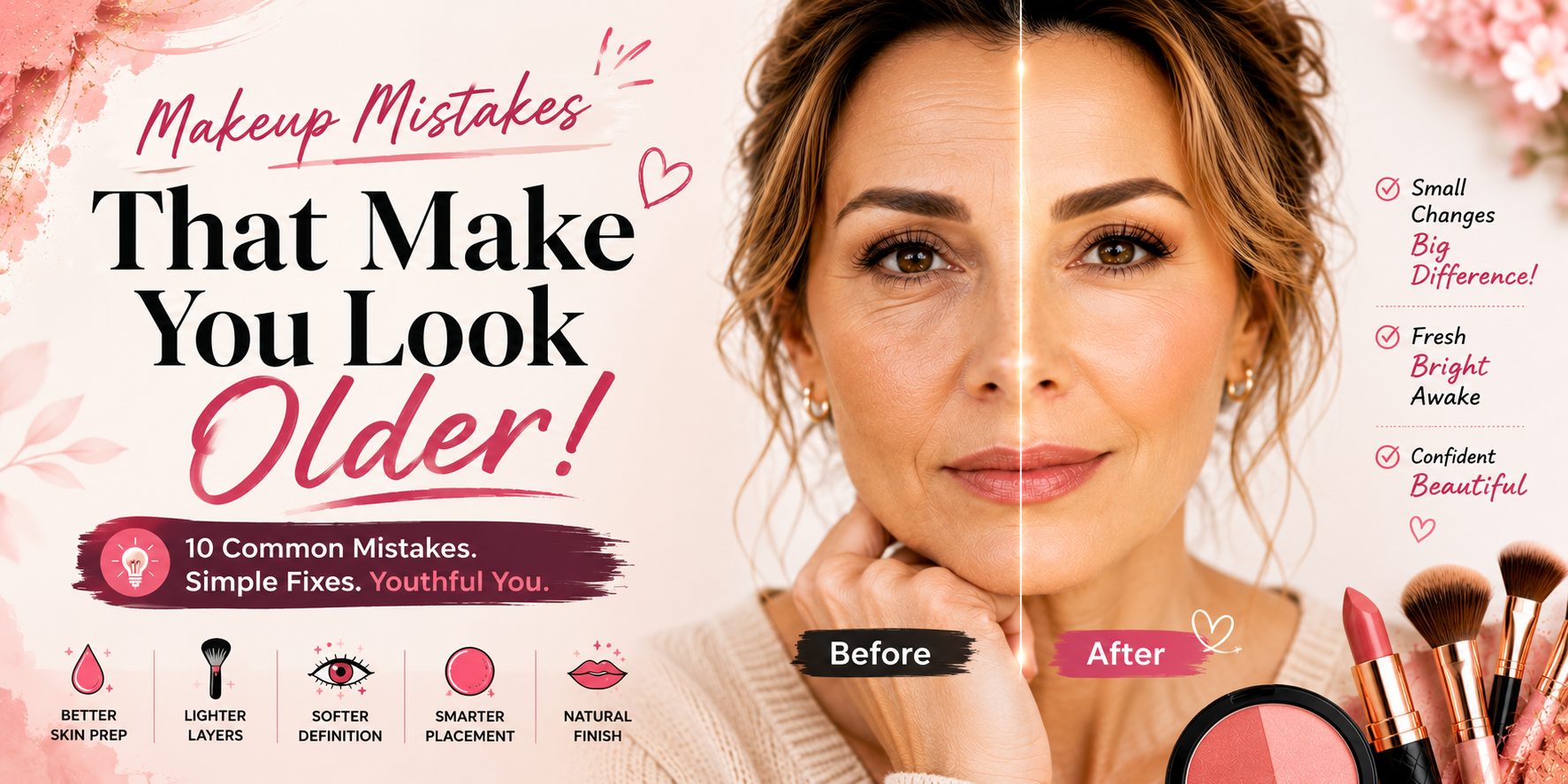
Makeup can enhance your natural features, brighten your complexion, and help you feel more confident. But the wrong makeup techniques can sometimes emphasize fine lines, dry skin, wrinkles, pores, and uneven texture, making the face appear older or more tired.
The good news is that you don’t need to stop wearing makeup—or buy an entirely new makeup collection. Small changes to your foundation, concealer, powder, blush, eyeliner, eyebrows, and lipstick can create a softer, fresher, more natural-looking finish.
Here are 10 common makeup mistakes that can make you look older, plus simple ways to fix them.
The makeup mistakes most likely to make you look older include applying too much foundation, using excessive powder, choosing an overly matte base, applying heavy under-eye concealer, wearing harsh eyeliner, over-defining the brows, placing blush too low, and using overly heavy lip makeup. Lighter layers, strategic placement, good skin preparation, and softer definition can create a more natural-looking result.
1. Using Too Much Foundation
Can heavy foundation make you look older?
It can. A thick layer of foundation may settle into fine lines, dry patches, pores, and uneven texture, making those features more noticeable. Trying to create completely flawless skin by adding more foundation can sometimes have the opposite effect.
Instead, aim for even-looking skin rather than completely covered skin.
How to fix this makeup mistake
- Apply a thin layer of foundation first.
- Start at the center of the face and blend outward.
- Add extra coverage only where you need it.
- Use concealer to target specific areas instead of adding more foundation everywhere.
- Choose a foundation finish that works with your skin type.
Lightweight, skin-like complexion products are often useful when you want to avoid a heavy or cakey makeup look. Heavy, mattifying foundation can be more likely to settle into fine lines and emphasize texture.
Makeup tip: Don’t worry about covering every pore or line. Allowing some natural skin to show can make your complexion look fresher.
2. Applying Too Much Setting Powder
Setting powder can help control shine and keep makeup in place. However, applying a thick layer across the entire face can emphasize dryness, fine lines, and skin texture.
Is setting powder bad for mature skin?
No. Setting powder isn’t inherently bad for mature skin. The problem is usually using too much or applying it where it’s not needed. A lighter application can set makeup while preserving a more natural-looking finish.
How to use setting powder correctly
- Use a small amount of finely milled powder.
- Concentrate it on areas that become oily or where makeup creases.
- Use less powder around the eyes.
- Avoid heavily powdering visibly dry areas.
- Press powder gently onto the skin instead of aggressively sweeping it across textured areas.
Recent makeup-artist guidance also recommends using powder strategically, particularly around areas such as the T-zone rather than automatically applying a heavy layer everywhere.
3. Choosing an Extremely Matte Foundation
A completely matte complexion isn’t necessarily a mistake. But if your skin is dry or textured, an excessively matte foundation can make those characteristics more noticeable.
What foundation finish is best for mature skin?
There is no single best foundation finish for everyone. However, a natural, satin, or skin-like finish can be a good option if you want to minimize the appearance of dryness and texture.
Try these makeup tips:
- Moisturize before applying makeup.
- Choose foundation based on your skin type.
- Consider a natural or satin finish.
- Use mattifying products only where needed.
- Don’t try to remove every trace of natural radiance.
The American Academy of Dermatology recommends moisturizer as part of a basic approach to managing the appearance of fine lines because moisturizing helps trap water in the skin.
Remember: A dewy finish isn’t automatically youthful, and matte makeup isn’t automatically aging. The goal is a comfortable, balanced complexion.
4. Using Too Much Under-Eye Concealer
The under-eye area has delicate skin, and applying too much concealer can cause makeup to settle into fine lines.
Another common mistake is choosing a concealer that is dramatically lighter than your skin in an attempt to make the eyes look brighter. Too much contrast can draw additional attention to the area.
How do you apply concealer without emphasizing wrinkles?
Use less concealer and place it strategically. Instead of covering the entire under-eye area, concentrate product where discoloration is most noticeable.
Try this technique:
- Start with well-moisturized skin.
- Apply a small amount of concealer.
- Focus on the inner corner or areas that actually need coverage.
- Blend the edges carefully.
- Set lightly only if necessary.
Less is often more when applying under-eye makeup.
5. Wearing Thick or Harsh Eyeliner
Eyeliner can beautifully define the eyes at any age. But a very thick, dark, or sharply drawn line can create strong contrast and make the eye area appear heavier.
That doesn’t mean you need to give up black eyeliner.
How can you wear eyeliner without making your eyes look older?
Keep the liner close to the lash line and soften the edges when appropriate. You can also experiment with brown, charcoal, or other softer shades.
Try these eyeliner tips:
- Keep the inner part of the line thinner.
- Concentrate definition along the upper lash line.
- Use softer shades if black feels too intense.
- Smudge the edge slightly for a softer effect.
- Avoid automatically lining the entire lower eye.
Your personal style matters. Bold eyeliner can still look sophisticated; these techniques are simply useful if you prefer a softer makeup look.
6. Over-Defining Your Eyebrows
Full, well-shaped eyebrows can frame the face beautifully. But brows that are too dark, heavily filled, or sharply outlined can make your makeup look harsh.
How should you do your eyebrows as you get older?
Use brow makeup to fill sparse areas and enhance your natural shape, rather than completely drawing a new eyebrow.
For natural-looking brows:
- Choose a shade that complements your natural brow color.
- Fill gaps instead of coloring the entire brow heavily.
- Use short, hair-like strokes.
- Brush through the brows with a spoolie.
- Keep the inner brow softer.
- Avoid an excessively sharp outline unless you intentionally want a dramatic look.
The goal is definition—not a solid block of color.
7. Applying Blush Too Low
Blush can instantly add color and life to the complexion, but placement changes the appearance of the face.
Applying blush too low on the cheeks can visually pull the face downward. For a more lifted-looking effect, many people prefer placing blush higher on the cheeks and blending it outward.
Where should you apply blush for a lifted look?
Start on the upper cheek area and blend outward toward the temples. Build the color gradually rather than applying a large amount at once.
Try this blush technique:
- Start with a small amount of blush.
- Apply it to the upper cheek area.
- Blend upward and outward.
- Avoid dragging the color too far downward.
- Check the overall effect from a normal viewing distance.
There isn’t one universally correct blush placement. Face shape, bone structure, makeup style, and personal preference all matter.
8. Using Lip Liner or Lipstick Too Heavily
Lip makeup can make a major difference to your overall appearance. But very heavy lip liner, extremely dry matte lipstick, or dark color applied without clean blending can emphasize lip texture.
How can you make lipstick look smoother on mature lips?
Start with comfortable, moisturized lips and use lip liner to subtly define your natural lip shape. Apply lipstick in a thin, even layer rather than building up excessive product.
Try these lip makeup tips:
- Keep lips comfortable and moisturized.
- Define the natural lip border.
- Avoid dramatically overdrawing unless that’s your intended look.
- Apply lipstick in a thin layer.
- Blot and reapply for longer wear.
- Choose a finish that works with your lip texture.
You don’t have to avoid red lipstick, dark lipstick, or bold lip colors as you get older. The right color and application can look elegant at any age.
9. Skipping Skin Prep Before Makeup
Even the best makeup products can look less flattering when applied over dry or irritated skin.
Good skin preparation doesn’t have to involve a complicated skincare routine. The American Academy of Dermatology recommends a straightforward order: cleanse, apply treatments if needed, moisturize and/or use sunscreen, then apply makeup.
What should you put on your skin before makeup?
A simple daytime routine can include:
Gentle cleanser → treatment, if needed → moisturizer → sunscreen → makeup
For daytime sun protection, dermatologists recommend broad-spectrum sunscreen with SPF 30 or higher.
Moisturizing can also help reduce the appearance of some fine lines by increasing water in the skin.
Don’t overdo your skincare
More products aren’t always better. Using multiple potentially irritating products can make the skin more irritated and make signs of aging more noticeable.
10. Using the Same Makeup Routine Forever
One of the most overlooked makeup mistakes over 40 and over 50 is assuming that the techniques that worked years ago will always work exactly the same way.
Your skin, facial contours, brow density, hair color, and personal preferences can change over time. Your makeup routine can change with them.
Should you change your makeup routine as you age?
Yes—if your skin or preferences have changed. You don’t need to follow rigid “anti-aging makeup” rules. Instead, reassess your foundation, concealer, powder, blush, brows, and eye makeup periodically.
Ask yourself:
- Does my foundation still match my skin?
- Does my foundation emphasize dryness or texture?
- Am I using too much powder?
- Does my concealer crease?
- Do my brows look natural?
- Is my blush placement flattering?
- Is my lipstick comfortable?
- Do I still like the way my makeup looks?
Sometimes changing one or two techniques is enough to refresh your entire makeup routine.
What Makeup Mistakes Make You Look Older?
The most common makeup mistakes that can make you look older are:
- Using too much foundation
- Applying excessive setting powder
- Choosing an overly matte base
- Using too much under-eye concealer
- Wearing harsh or heavy eyeliner
- Over-darkening the eyebrows
- Applying blush too low
- Using heavy lip makeup
- Skipping skin preparation
- Never updating your makeup routine
These mistakes don’t actually accelerate biological aging. Instead, they can make existing fine lines, dryness, wrinkles, pores, and skin texture appear more noticeable.
How Can You Make Your Makeup Look More Youthful?
You don’t need more makeup to create a fresher appearance. In many cases, the key is using less product and placing it more strategically.
Start with these simple changes:
- Use lightweight foundation.
- Apply concealer only where needed.
- Set makeup selectively with powder.
- Choose a natural or satin finish if it suits your skin.
- Keep eyeliner close to the lash line.
- Fill brows with light, hair-like strokes.
- Blend blush upward and outward.
- Keep lips moisturized.
- Prepare your skin before makeup.
- Update your makeup routine as your skin changes.
The goal isn’t to hide every wrinkle or pore. A polished complexion that still looks like skin can often appear more natural than heavy, highly layered makeup.
Does Makeup Actually Make Your Skin Age Faster?
Makeup itself does not automatically cause your skin to biologically age faster. However, makeup and cosmetic habits can affect skin health.
For example, wearing old or contaminated eye cosmetics can increase the risk of eye infections. The FDA notes that manufacturers generally recommend discarding mascara two to four months after purchase, and dried mascara should not be revived with water or saliva.
It’s also important to remove makeup before bed and avoid products that irritate your skin.
For long-term skin health, sun protection matters much more than trying to find a magical “anti-aging” makeup product. The AAD recommends broad-spectrum SPF 30 or higher as part of daily sun protection.
Makeup Routine for Mature Skin: Step by Step
If you’re looking for an easy makeup routine for mature skin, keep it simple.
Step 1: Prep your skin
Cleanse gently and apply moisturizer appropriate for your skin type.
Step 2: Apply sunscreen
Use broad-spectrum SPF 30 or higher during the day.
Step 3: Apply foundation
Use a thin layer and build coverage only where necessary.
Step 4: Apply concealer
Target dark circles, redness, or discoloration instead of covering everything.
Step 5: Add blush
Apply a small amount to the upper cheek area and blend outward.
Step 6: Define your eyes
Use eyeliner close to the lash line and soften it if desired.
Step 7: Shape your brows
Fill sparse areas with light strokes and brush through.
Step 8: Add lip color
Define the natural lip shape and apply a comfortable lipstick or lip product.
Step 9: Set strategically
Use a small amount of powder only where you need it.
This approach can create a polished makeup look without making the skin appear overly covered.
Frequently Asked Questions About Makeup That Makes You Look Older
What makeup makes you look older?
Heavy foundation, excessive powder, overly matte makeup, thick under-eye concealer, harsh eyeliner, overly dark brows, and poorly placed blush can make skin texture and facial features appear heavier. The effect depends on the individual, but reducing product and using more strategic placement can create a softer appearance.
Does foundation make you look older?
Foundation doesn’t inherently make you look older. However, applying too much foundation or choosing a formula that doesn’t suit your skin can cause makeup to settle into fine lines and emphasize dryness or texture.
Is powder bad for mature skin?
No. Powder can be useful for setting makeup and controlling shine. The key is applying it selectively. Too much powder, particularly on dry or textured areas, can make the complexion look flat or emphasize fine lines.
What is the best foundation for mature skin?
There is no universally best foundation for mature skin. Look for a formula that suits your skin type, desired coverage, climate, and preferred finish. If dryness or texture is a concern, a lightweight foundation with a natural or satin finish may be a useful starting point.
Is matte or dewy makeup better for mature skin?
Neither is automatically better. A very matte finish may emphasize dryness for some people, while an overly dewy finish may look too shiny or move around. A natural or satin finish can be a versatile middle ground.
Does eyeliner make you look older?
Not necessarily. Eyeliner can define the eyes beautifully at any age. Very thick or harsh lines may create strong contrast and visually weigh down the eye area, so softer lines can be useful if you want a more subtle effect.
Where should you put blush to look younger?
For a lifted-looking effect, try placing blush on the upper part of the cheeks and blending outward and slightly upward. However, the best placement depends on your face shape and bone structure.
Should women over 40 stop wearing dark lipstick?
No. Dark and bold lipstick can look beautiful at any age. If you want a softer effect, focus on comfortable lip texture, clean application, and a shade that complements your coloring.
How often should you replace mascara?
The FDA says manufacturers generally recommend discarding mascara two to four months after purchase because the wand can become exposed to bacteria and fungi during use. Dried mascara should also be discarded rather than diluted.
Does sunscreen help prevent premature skin aging?
Yes. UV exposure contributes to premature skin aging, including wrinkles and age spots. The AAD recommends broad-spectrum SPF 30 or higher as part of regular sun protection.
Final Thoughts: Makeup Doesn’t Have to Hide Your Age
The best anti-aging makeup tips aren’t about following strict rules or trying to look dramatically younger. They’re about choosing products and techniques that work with your skin today.
Use lighter foundation, apply powder strategically, avoid unnecessarily harsh definition, place blush thoughtfully, keep your lips comfortable, and prepare your skin before makeup.
Most importantly, makeup should help you feel confident—not make you feel that you have to hide your age.